
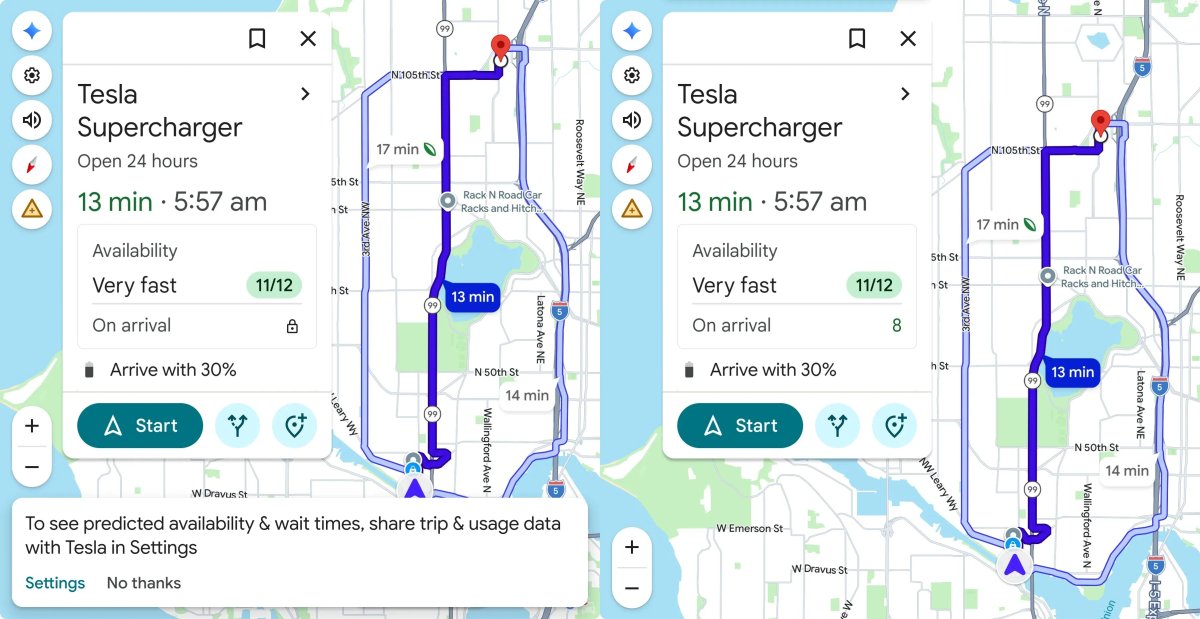

Google Maps is rolling out a feature that uses intelligent data modeling to forecast Tesla Supercharger stall availability on third-party EV displays, helping non-Tesla drivers plan trips and avoid arriving at fully occupied stations.
Predictive data for built-in navigation
Tesla announced on X:
"Forecasted stall availability is rolling out globally to eligible EVs with Google Maps built-in. This feature lets EV drivers know predicted Supercharger availability ahead of time. Opt in to access predictions and help optimize charging for all drivers."
This builds on earlier EV additions in Google Maps: live Tesla Supercharger availability arrived last fall, followed more recently by AI-powered EV trip routing.
In the charger details, a new "On arrival" row appears beneath the live plug count. It is disabled by default; turning it on prompts you to share trip and usage data with Tesla in Google Maps settings. Once enabled, Maps displays how many stalls are expected to be open when you reach the site.

Optimizing the global charging grid
The update chiefly benefits owners of non-Tesla EVs whose vehicles use Google Maps-powered navigation, such as Rivian models. Tesla vehicles already show both live and predicted Supercharger stall counts in the built-in navigator, but the change can still add helpful context for Tesla owners using the Google Maps smartphone app while traveling.
Tesla can forecast availability for its own fleet because it knows how many cars are navigating to each location. When third-party EV drivers opt in to share trip and usage data with Tesla through Google Maps, it creates a new stream of information that could also include routing from other EVs, improving the accuracy of availability predictions for everyone.
With the Supercharger network now open to other brands, congestion management is increasingly important. Tesla operates the largest fast-charging network on Earth, recently passing 80,000 Supercharger stalls worldwide. The company introduced AI-powered Supercharger forecasting for its vehicles in April to reduce wait times and is also testing a virtual queuing feature at some of its busiest sites. Sharing these data streams across platforms helps keep lines short as compatibility and the network continue to expand.





Share:
Tesla Cybercab Won't Need Brake Pedals Under New NHTSA Rules
Tesla Trademarks Megapod; Will Turn Idle Superchargers Into Distributed Compute