
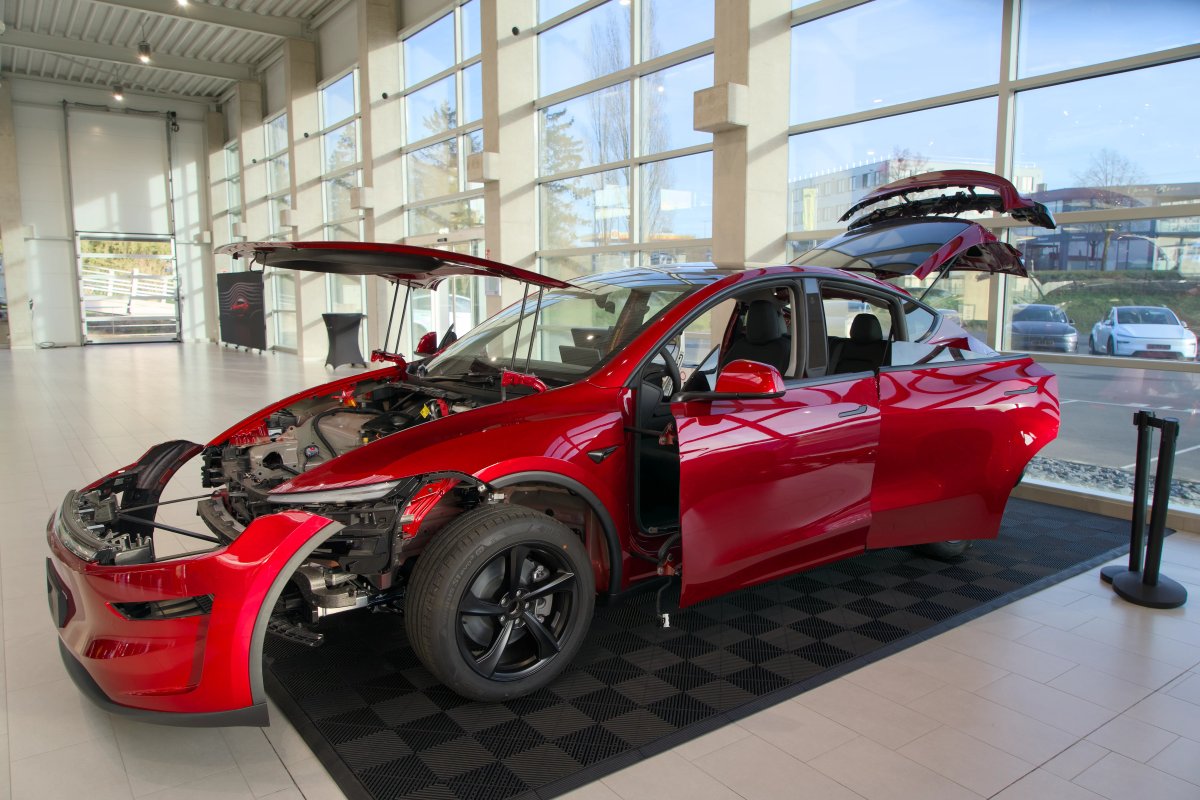
Tesla has created a studio exhibit that puts its manufacturing hardware on display. X user @DriveGreen80167 shared footage of a deconstructed Model Y arranged in an "exploded view" in China, letting viewers see how the world’s best-selling electric vehicle is assembled, from the bare metal frame to complex internal wiring.

Tesla puts everything on display for everyone to see clearly, because just looking brings true peace of mind. $tsla pic.twitter.com/vaLZkt7jai
— DriveGreenLiveGreen (@DriveGreen80167) March 9, 2026
Similar displays have also been seen at delivery centers in Europe, notably in Luxembourg. Presenting the car disassembled in a studio spotlights manufacturing practices that have reshaped how cars are built.
The Magic of Gigacasting
A standout element in the display is Tesla’s revolutionary "gigacasting" process. Traditionally, a car's frame is assembled by welding dozens of small, stamped metal pieces. Tesla instead uses massive casting machines, called Giga Presses, to create large, single-piece aluminum structures for the vehicle’s front and rear.

This approach simplifies assembly, cuts manufacturing costs, and significantly reduces vehicle weight. With fewer parts and joints, the structure is stiffer and has fewer potential failure points, aiding long-term durability. Studies have shown that Tesla vehicles are among the cheapest to maintain and repair over time, largely due to these streamlined production decisions.

Peace of Mind Through Transparency
The "exploded" Model Y also exposes seat frames, battery-pack integration, and simplified cooling systems. Seeing the components laid out clarifies why many rivals are attempting to emulate Tesla’s manufacturing approach: the build complexity is lower than in a traditional gas car, which can mean fewer failure points for owners.

Displaying the vehicle’s "bones" in public underscores a focus on transparency, demonstrating that the underlying engineering is as clean and efficient as the software experience.
As Tesla further refines these methods at Gigafactories worldwide, such deconstructed showcases highlight the company’s impact on the auto industry. The same gigacasting and new "unboxed" methods are expected to underpin Tesla’s upcoming Cybercab and future models.









Share:
Ashok Elluswamy to Lead Macrohard — Tesla and xAI Joint Venture
The Great Robotaxi Race: A Look at Tesla’s Competition