
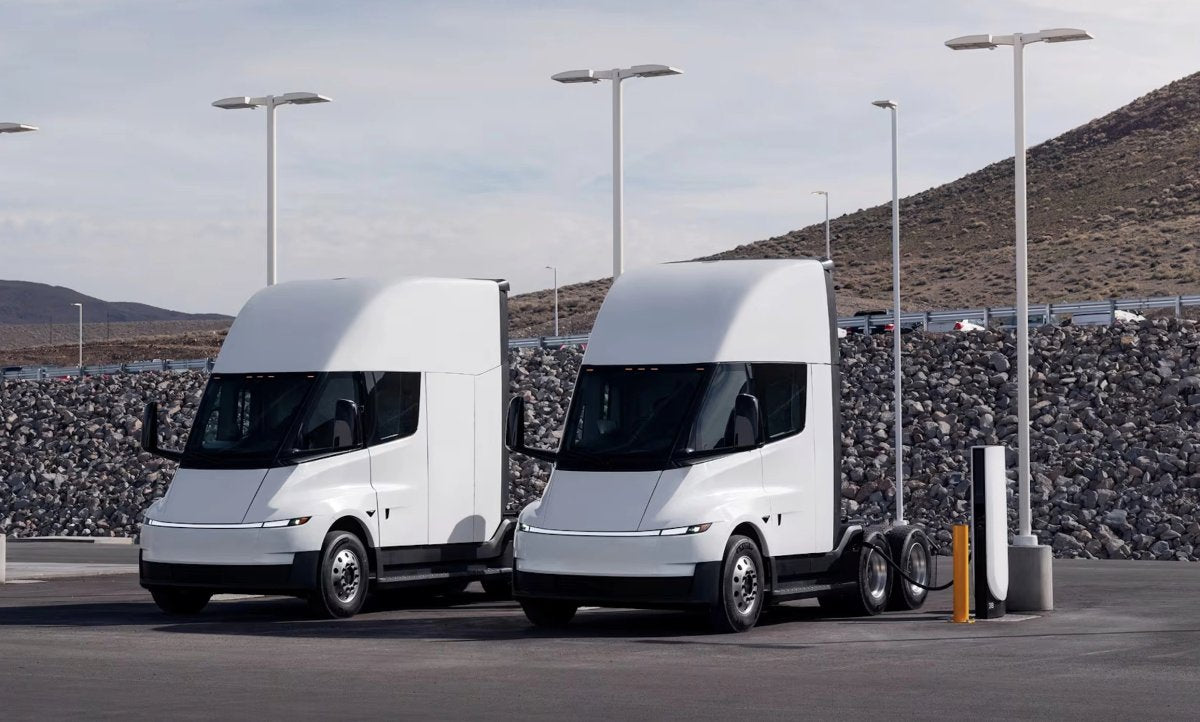

A newly released regulatory filing from the California Air Resources Board (CARB) discloses the battery capacities for both production versions of the Tesla Semi.
The documents specify that the Long Range uses an 822 kWh pack, while the Standard Range is equipped with a 548 kWh pack. For context, AWD, Long Range trims of the Model 3 and Model Y typically have about a 75–80 kWh battery, making the Long Range Semi’s pack roughly 10x larger in energy capacity.
4680 Battery Specs
Per the CARB Executive Order certifying the 2026 model-year powertrain, the Semi employs a Lithium-ion NMCA chemistry. NMCA offers higher energy density than an equivalent-weight LFP pack.
The Long Range variant has an exact usable capacity of 822 kWh and a peak power rating of 800 kW. The Standard Range variant uses a 548 kWh pack and delivers 525 kW of peak power to meet its targeted 325-mile range. Estimated ranges for both versions are calculated at a maximum gross combination weight of 82,000 pounds.
Both configurations are built around Tesla’s 2nd-gen 4680 cell architecture, the Cybercell, and can sustain a 1,200 kW (1.2 MW) peak charging rate.
| Variant | Usable Capacity | Estimated Range* | Peak Charging | Peak Power |
|---|---|---|---|---|
| Standard Range | 548 kWh | 325 Miles | 1.2 MW | 525 kW |
| Long Range | 822 kWh | 500 Miles | 1.2 MW | 800 kW |
*Range estimated at a maximum gross combination weight of 82,000 pounds.
The Semi’s Efficiency
Using the official figures, achieving 500 miles of range with an 822 kWh pack equates to an energy use of 1.64 kWh per mile for the Long Range Semi.
For comparison, the Model 3 consumes about 0.250 kWh per mile. The Model 3 weighs around 4,000 lbs, while the Semi’s fully loaded weight is 82,000 lbs.
When the program was first outlined, Tesla stated the truck would consume less than 2 kWh per mile under a full load. The CARB filing shows the Semi remains below that 2 kWh per mile threshold.
Every fraction below 2 kWh per mile translates into notable efficiency gains for logistics operators.
Why Cybercell?
Tesla’s choice to use the Cybercell for the Semi prompted comparisons with less expensive LFP cells. Building a Class 8 battery pack requires balancing maximum energy density to keep tractor weight down with the thermal stability needed for commercial fast charging.
By employing NMCA 4680 cells, the pack can handle the thermal load of the Megawatt Charging System. Sustaining 1.2 MW of charging power enables the Semi to add roughly 300 miles of range in approximately 30 minutes.
This capability supports fleet operations with turnaround times comparable to conventional diesel trucking.



Share:
Tesla Vision Can Deploy Airbags Before You Even Hit Anything
Tesla Ends Model S and X Production: The Signature Edition Fiasco Explained