
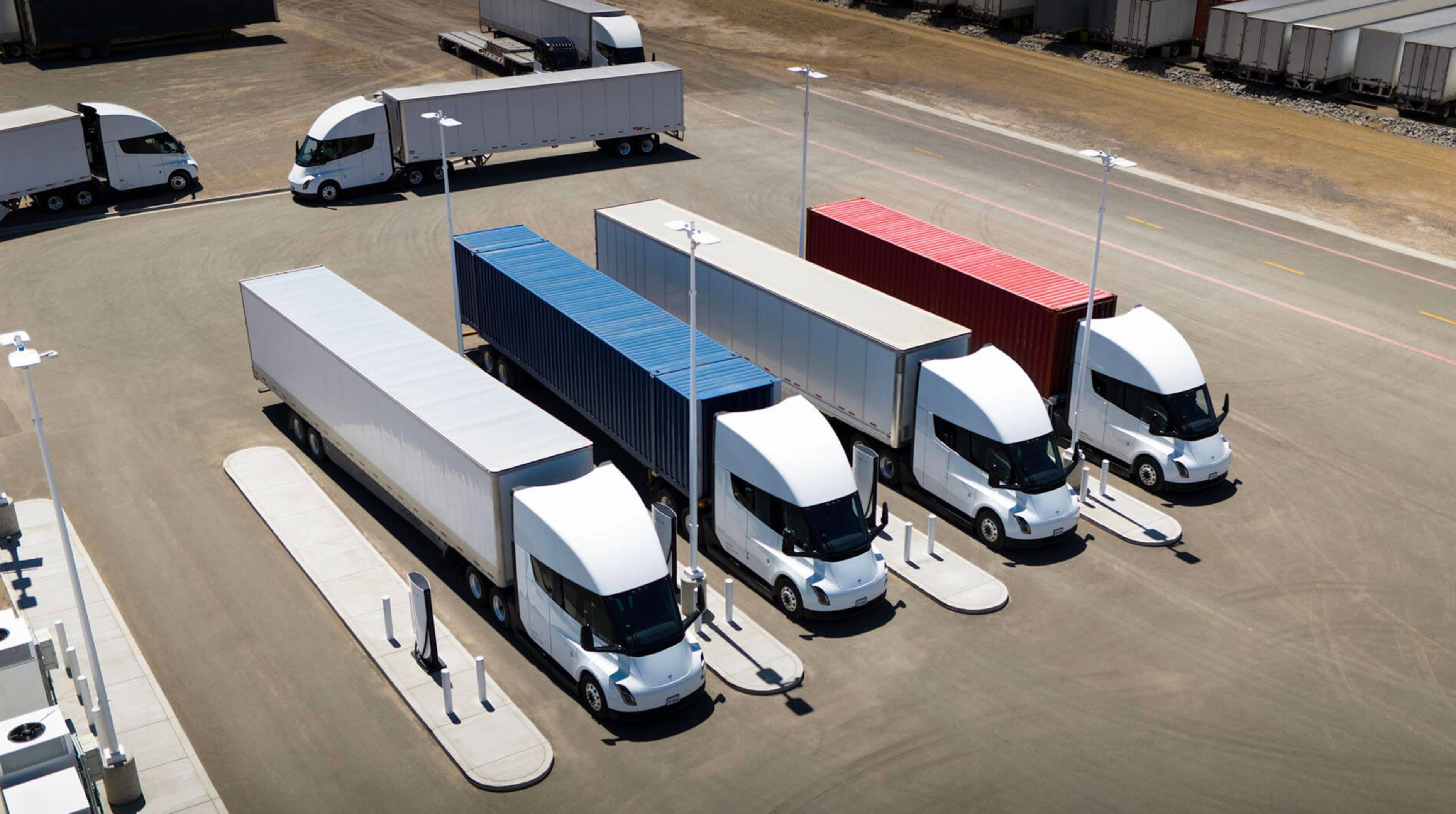

Fleet operators have been asking the same question for three years: "Where exactly am I supposed to charge this thing?"
Tesla promised the Semi would revolutionize trucking. But without a real charging network, it was a promise without infrastructure. That just changed — and the Reddit trucking community is paying very close attention. Here's what Tesla doesn't want its competitors to know: the first customer-facing Megacharger just went live, and 65 more are coming.
⚡ Quick Answer
First Customer Station
Ontario, CA (4265 E Guasti Rd) — opened March 8, 2026, at the I-10/I-15 interchange in the Inland Empire freight corridor
Charging Speed
Up to 1.2 MW (750 kW at Ontario), enough to replenish 60% of Semi range in ~30 minutes during mandatory driver rest breaks
Network Scale
66 planned locations across 15 US states — 37 sites targeted for 2026, 46 by early 2027
Production Status
Mass production starting 2026 — Standard Range (325 mi) and Long Range versions confirmed by Elon Musk
The Tesla Semi has been in limited production since 2022, hauling freight for PepsiCo and Tesla's own supply chain. But the program has always had one glaring gap: public charging infrastructure built for fleet operators, not just Tesla's internal use. That gap is now closing — fast.
Here's what you need to know. In the past 30 days, Tesla has opened its first customer-facing Megacharger, announced 64 new network locations, and signed a deal with Pilot Flying J — the largest truck stop operator in America. No fluff.

Why Ontario, California Was the Perfect First Move
Location selection in trucking infrastructure is everything. Tesla didn't open its first customer Megacharger in a tech hub or near a showroom. They put it at 4265 E Guasti Road in Ontario, California — right at the intersection of the I-10 and I-15 freeways, in the heart of the Inland Empire.
The Inland Empire is the beating heart of goods movement in Southern California. Every day, thousands of trucks move freight between the Ports of Los Angeles and Long Beach — the two busiest container ports in the Western Hemisphere — and massive distribution centers further inland. Amazon, Walmart, FedEx, and virtually every major retailer in America has warehousing in this corridor.
Real Owner Quote: "Finally. The Inland Empire location makes total sense — that's where the actual freight moves. If you're running drayage from the ports, you need charging right there, not 50 miles away." — Reddit user r/TeslaMotors, March 2026
Tesla also has a second operational site in Carson, California, near the 405 and 110 freeways and the Port of Long Beach. Together, these two stations form the beginning of a real charging corridor for electric trucks serving the LA basin — arguably the most important freight market in the US.
The Numbers Behind 1.2 MW Charging
What 750 kW Actually Means for Fleet Operators
The Ontario station currently operates at 750 kW — below the 1.2 MW maximum Tesla's Megachargers are rated for. But even at 750 kW, the math works for fleet operators in a way that nothing else currently does.
60% Range in 30 Minutes
Federal regulations require truck drivers to take a 30-minute break after 8 hours of driving. At 750 kW, a Tesla Semi can recover 60% of its range during that mandatory rest — meaning the charging stop costs the fleet operator exactly zero additional time. The truck charges while the driver rests.
Full 1.2 MW Capability Coming
Tesla has already demonstrated 1.2 MW charging in December 2025. As the network scales and grid connections are upgraded, expect the full power output to become standard. At 1.2 MW, the charging math becomes even more favorable for longer routes.
Comparison to Diesel Refueling
A diesel truck refueling stop takes 15-20 minutes. The Semi's charging stop aligns with the mandatory rest break, effectively making it "free time" in the schedule. For regional haul routes under 500 miles, the Semi can complete the run without any charging at all.
The 66-Location Network: Where Tesla Is Building
In February 2026, Tesla updated its "Find Us" map with 64 new Megacharger locations, bringing the total planned network to 66 sites across 15 states. The distribution reveals Tesla's strategic thinking about the US freight market.
Top States by Planned Sites
- Texas — 19 sites (largest freight market)
- California — 17 sites (ports + distribution)
- Florida, Georgia, Illinois — major corridors
- 13 additional states with planned coverage
Key Interstate Corridors Targeted
- I-5 — West Coast north-south artery
- I-10 — Southern east-west corridor
- I-95 — East Coast north-south spine
- I-75 — Southeast distribution corridor
The Pilot Flying J partnership adds another layer. Pilot operates over 750 travel centers across the US — the most extensive truck stop network in the country. Tesla's deal to install Megacharger stalls at select Pilot locations, expected to open by summer 2026, means the Semi will have access to established truck stop infrastructure rather than requiring entirely new facilities.
Real Owner Quote: "The Pilot deal is what makes this real for me. Pilot is everywhere. If Tesla Semi can charge at Pilot stops, that's a completely different conversation for fleet managers." — Reddit user r/electricvehicles, February 2026
Tesla vs. the Competition: Who's Actually Ready?
Tesla isn't the only company building electric Class 8 trucks. Daimler, Volvo, and Scania (part of the Traton Group) are all preparing MCS-compatible electric trucks for commercial deployment in 2026. The Megawatt Charging System (MCS), an open industry standard supporting up to 3.75 MW, is gaining traction in Europe and the US.
Tesla Semi Advantages
- Trucks already on the road since 2022
- Customer-facing charging infrastructure live
- Integrated software and OTA updates
- Proven 500+ mile range in real-world use
MCS Competitor Advantages
- Open standard (not proprietary)
- Up to 3.75 MW charging (3x Tesla)
- Established dealer/service networks
- European market experience
The critical difference: Tesla already has trucks on the road and chargers plugged in. Competitors are still largely in the announcement phase for megawatt-class charging in the US. Kempower is deploying MCS infrastructure at a truck fleet hub in San Bernardino — not far from Tesla's Ontario station — but it's targeting a different customer base with different hardware.
For fleet operators making purchasing decisions today, the question isn't which technology is theoretically superior. It's which one has working infrastructure right now. That first-mover advantage matters enormously in an industry where fleet managers need to see charging stations before signing truck purchase agreements.
What the Reddit Community Is Actually Saying
The Tesla Semi Megacharger announcement generated significant discussion across r/TeslaMotors, r/electricvehicles, and r/TeslaLounge this week. The sentiment is notably different from typical Tesla hype — this is a more measured, operationally-focused conversation.
Real Owner Quote: "Pictures of Tesla's first ever Public Semi Megacharger station in Ontario CA" — u/1FrostySlime, r/TeslaMotors, 1 day ago (107+ comments, 1K+ upvotes)
The most upvoted comments focused on the strategic location choice, the charging speed relative to driver rest requirements, and the pace of network expansion. Several fleet operators commented that the Ontario location specifically addresses their drayage operations between the ports and inland warehouses.
Skeptics raised valid questions about the gap between 66 planned locations and the 37 targeted for 2026. Permitting, utility interconnection, and construction timelines are real bottlenecks. But the community consensus was that Tesla's momentum — 1.2 MW demo in December, 64-location map update in February, Pilot deal in January, customer station in March — represents genuine acceleration, not just announcements.
Should Your Fleet Consider Tesla Semi? A Decision Framework
✓ Strong Fit — Consider Tesla Semi If:
- Routes are under 500 miles (regional/drayage)
- Operations near planned Megacharger locations
- Sustainability commitments require electrification
- Depot charging infrastructure is feasible
- Willing to be early adopter for competitive advantage
✓ Wait and Watch — Reconsider If:
- Routes exceed 600+ miles regularly
- Operating in states without planned Megacharger coverage
- Need open-standard charging compatibility
- Service network coverage is a primary concern
- Budget constraints require proven ROI data
The Bottom Line
Tesla's first customer Megacharger isn't just a charging station — it's the moment the Semi program stopped being a pilot and started being a product.
The Ontario location, the 66-site network plan, the Pilot Flying J partnership, and the mass production ramp happening simultaneously represent a coordinated push that Tesla's competitors simply cannot match right now. Daimler, Volvo, and Scania have better charging standards on paper. Tesla has actual chargers in the ground and trucks on the road.
For fleet operators, the calculus is shifting. The question is no longer "will there be charging infrastructure?" The question is now "can Tesla build 37 stations by the end of 2026 as promised?" If they can, the electric trucking transition in the US will look a lot like the EV transition for passenger cars — and Tesla will have the same first-mover advantage it has held for a decade.
Last updated: March 9, 2026









Share:
Tesla's 'Haha, Yes' Hedgehog: What It Means and Where It Came From
Tesla Recalls Early Cybertrucks Over Drive Inverters: How to Check If You're Affected