
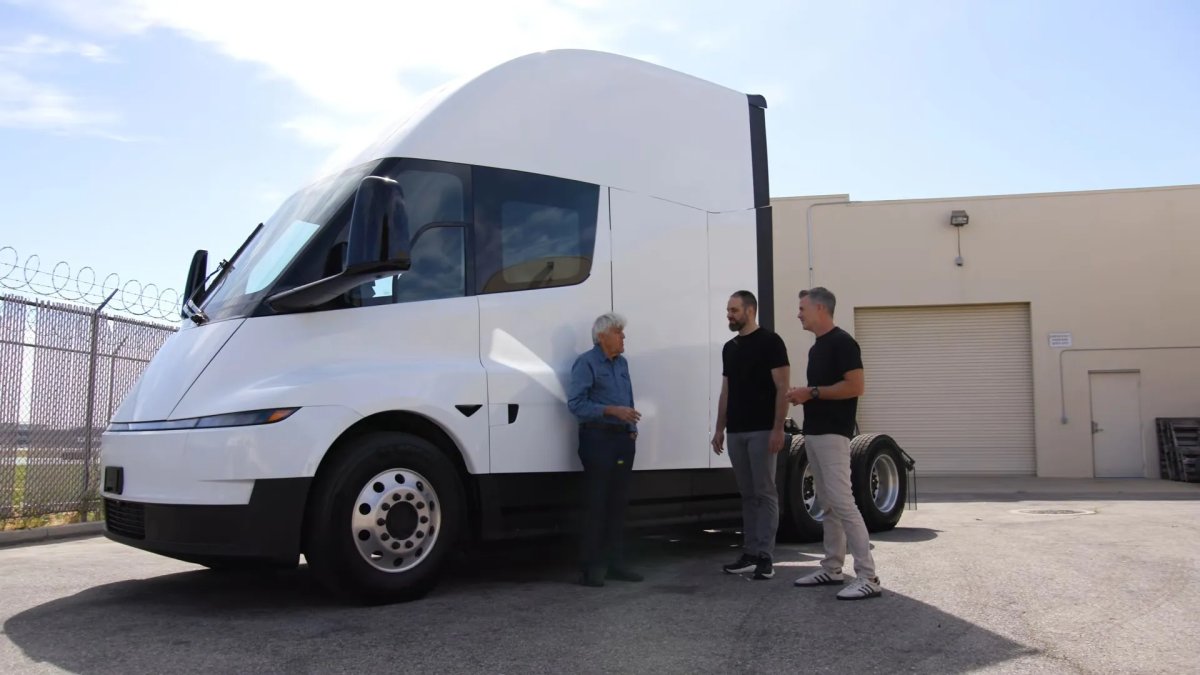
Tesla plans to begin high-volume production of the Semi later this year. To demonstrate recent progress on the electric Class 8 truck, Jay Leno reviewed a production-intent vehicle alongside Tesla’s Chief Designer, Franz von Holzhausen, and Semi Program Director, Dan Priestley, in a 47-minute video.

Shedding Weight & Boosting Efficiency
Priestley said the latest version is roughly 1,000 pounds lighter. With a 2,000-pound EV weight exemption, the 500-mile Long Range model is now close to diesel trucks in total hauling capacity. He also confirmed the Semi supports charging up to 1.2 megawatts, enabling a 60% recharge in about 30 minutes.
Cybertruck Tech & 4680 Cells
As the program moves toward mass production at a new facility outside of Giga Nevada, it is adopting several technologies introduced with Cybertruck. The Semi now uses fully electric steering assist instead of hydraulic assist. Although it is not steer-by-wire, it employs strengthened steering actuators derived from Cybertruck to manage vehicle mass.
Tesla's @danWpriestley has revealed more information abbot the redesigned Tesla Semi:
— Sawyer Merritt (@SawyerMerritt) March 23, 2026
• Now uses fully electric steering assist (vs hydraulic before)
• Uses beefed up Cybertruck actuators
• 48 volt architecture
• 4680 cells, designed to last 1M miles
via Jay Leno's Garage pic.twitter.com/xh6rZ9mZ0q
The truck has switched to a low-voltage 48-volt architecture, removing heavy wiring harnesses and improving manufacturing efficiency.
Its drivetrain is supplied by a structural battery pack using Tesla’s 4680 lithium-ion cells. Priestley said the pack is engineered to last 1 million miles with minimal degradation. The pack is cube-shaped rather than flat, helping it retain heat in cold conditions so it doesn’t need to consume energy to stay warm during longer idle periods. Cooling for the battery is now independently controlled.
Dedicated Torque Axle
The Semi uses a dual-axle powertrain tuned for different tasks instead of a multi-speed transmission. The front torque axle is geared for heavy acceleration and climbing steep grades; at highway speeds it disengages internally to eliminate drag. An efficiency axle then handles cruising.
Standard vs. Long Range

While Leno drove the 500-mile Long Range model, Priestley also presented the Standard Range variant rated at 325 miles per charge.
The primary difference is in battery configuration: the Long Range version uses three battery modules in parallel, while the Standard Range uses two.
With two modules, the Standard Range adopts a shorter wheelbase, making it lighter, less expensive, and more maneuverable. Priestley noted its turning radius is about the same as a Tesla Model Y.
Tesla says the Tesla Semi Standard Range (325 mile range), which has a shorter wheelbase than the Semi Long Range (500 mile range), has about the same turning radius as a Model Y.
— Sawyer Merritt (@SawyerMerritt) March 23, 2026
Jay Leno driving the redesigned Tesla Semi in his new video: "Nice turning radius. Boy that's… pic.twitter.com/KZCDWTqxNo
During rides, it’s common for drivers to comment on how good the turning radius is, but they’re only 3/4 of the way to lock. I’ll chime in “oh you can keep going” and they turn the wheel more and are blown away. Maneuvering in tight urban spaces is critical.
— Dan Priestley (@danWpriestley) March 23, 2026
Wireless Charging Potential
Priestley reiterated that the Semi currently supports 1.2-megawatt fast charging to recover 60% of its battery in roughly 30 minutes, and said the team is exploring automated wireless charging. An inductive pad at depots or loading docks could eliminate handling heavy liquid-cooled cables and speed fleet turnarounds. This builds on wireless charging development planned for the Cybercab network.
Refrigeration Units / Powershare

A modified version of Powershare from Cybertruck lets the Semi power refrigerated trailers without a separate generator—just plug it in—reducing hardware and cooling costs. Because it is a standard electrical hookup, it can also power an RV or other types of trailers.
Unmatched Fleet Reliability
Priestley shared operational results from pilot fleets: a few hundred trucks have accumulated more than 13.5 million miles, with the lead truck at nearly 440,000 miles. The fleet reports about 95% uptime. When problems occur, 80% of issues are resolved and the truck is returned to the customer in under 24 hours, with half of those fixed in less than an hour.







Share:
Elon Musk’s Boring Company to Build Three New Tunnel Projects for Free
Lucid’s New Gravity — Here’s How It Compares to Tesla