
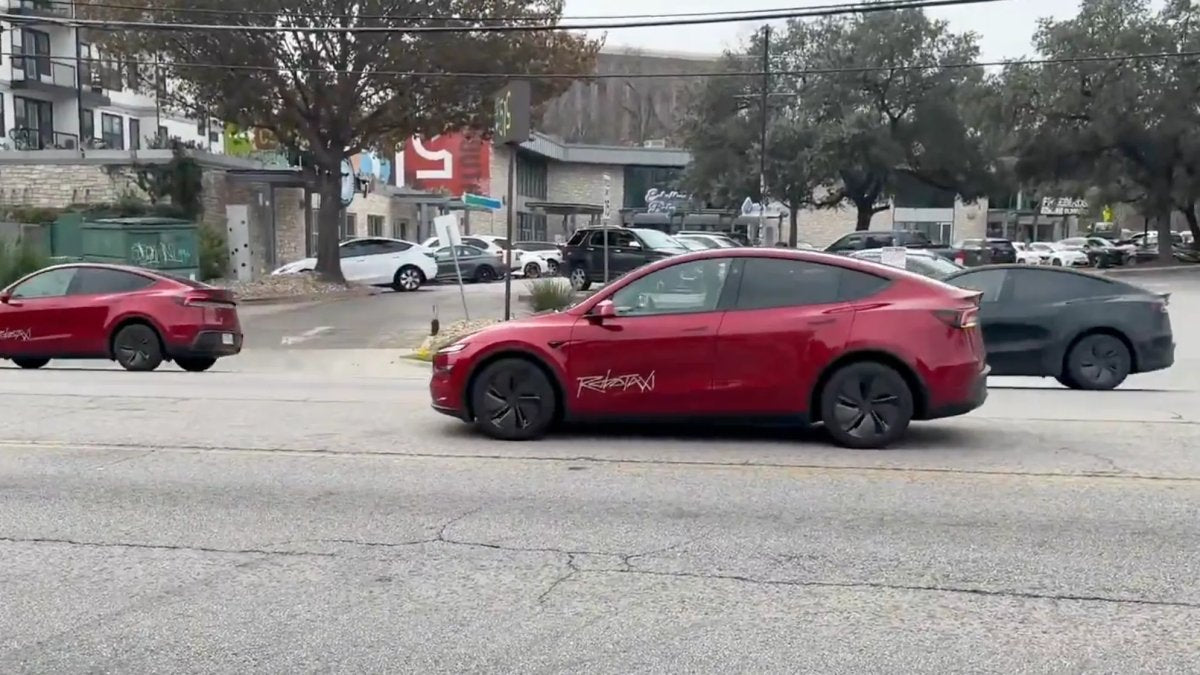

Recent coverage from publications such as Wired and Engadget noted that Tesla’s Robotaxis can be driven remotely by humans. According to Tesla’s stated approach, this teleoperation capability is intended as a practical safeguard for real-world operation.
Solving Autonomy in a Flawed World
The transition to fully autonomous driving includes difficult edge cases. Incidents involving competitors like Waymo have shown situations where multiple autonomous vehicles became confused at intersections, producing traffic jams made up entirely of driverless cars.
In some instances, remote operators have guided vehicles out of gridlock, and during the early operation of the now-defunct Cruise network, employees even performed manual physical interventions to free stuck vehicles.
The stakes rise when emergency vehicles are involved. An autonomous vehicle that blocks an ambulance or a firetruck due to an inability to interpret a complex diversion creates a public-safety risk. Tesla’s remote-control capability is designed to help prevent such scenarios.
Final Escalation
In correspondence between Karen Steakley, Tesla’s director of public policy and business development, and Senator Ed Markey of Massachusetts, Steakley stated that Tesla employs highly trained Remote Assistance Operators at facilities in Austin and Palo Alto to monitor the Robotaxi fleet.
According to Steakley, these operators serve as a redundancy in rare situations and may temporarily assume direct vehicle control only as a final escalation after all other intervention options have been exhausted. They do not transport passengers to destinations; their role is limited to emergency extraction.
Strict Limits and Safety
When a Remote Assistance Operator takes over, capabilities are tightly constrained. Steakley noted that operators can take temporary control at speeds up to or less than 2 mph, and—if the vehicle’s onboard software explicitly permits it based on the surrounding environment—can drive the Robotaxi remotely at speeds up to 10 mph.
Steakley added that this enables Tesla to quickly move a vehicle out of a compromising position, clear a path for first responders, or carefully navigate an unmapped construction zone that the neural network cannot process.
A Necessary Safety Net
Operating an autonomous fleet requires contingency measures beyond neural-network performance. Some autonomous-vehicle companies have been hesitant to allow direct remote control due to concerns about network latency, but Tesla’s low-speed parameters are intended to mitigate that risk.
Allowing a human to nudge a stuck Robotaxi out of a critical intersection at 2 mph is intended to reduce the kinds of pileups seen during early autonomous rollouts and to help keep the broader Robotaxi service safe, functional, and unobtrusive to emergency responders.





Share:
Tesla Hits 80,000 Superchargers With Huge Site in France
Tesla’s 6-Seat Model Y L Hits 8 New Markets in Asia