
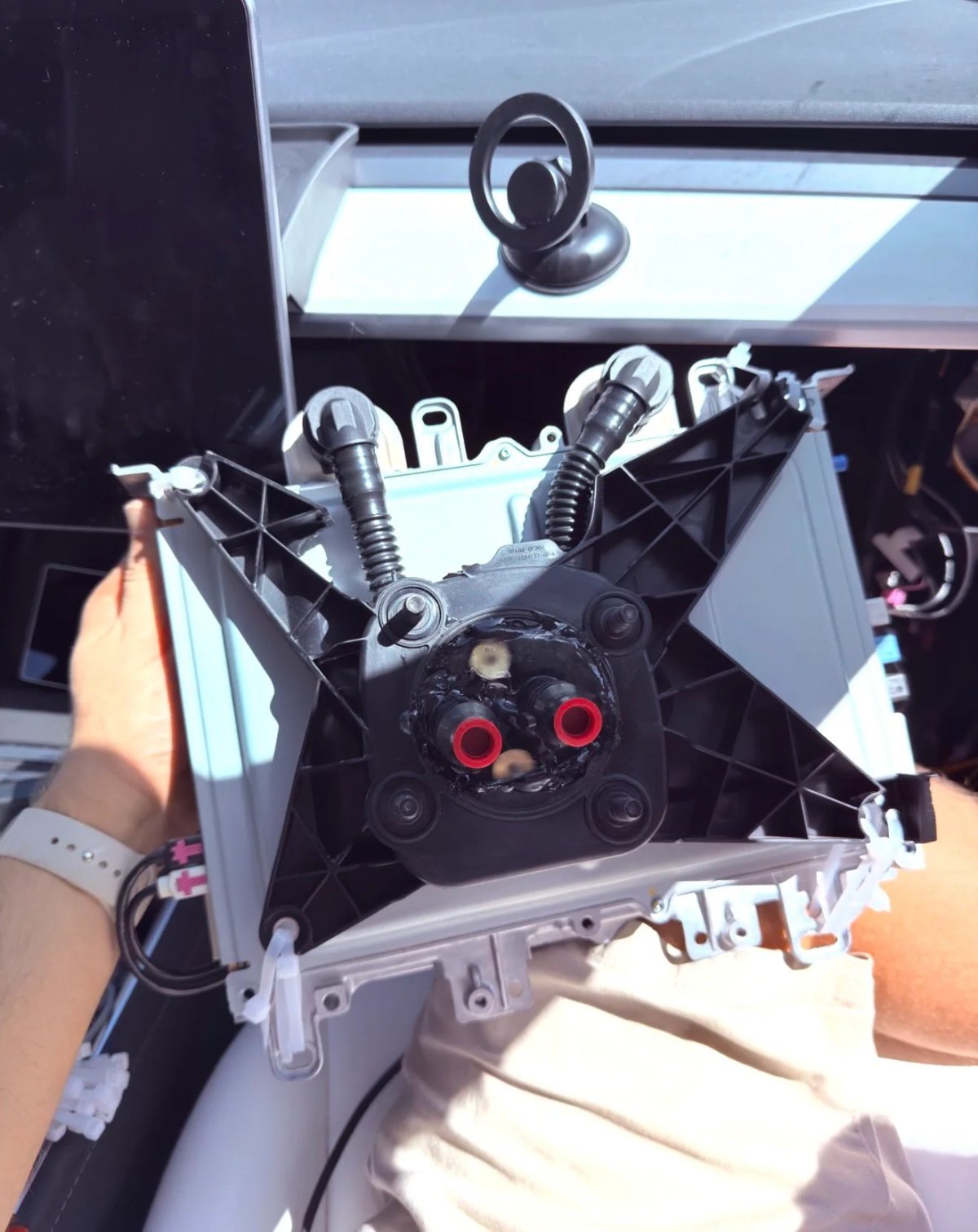
Impatient with the lack of official hardware retrofits for older vehicles, developer Michał Gapiński — known for the Tesla Android project that unofficially brings Apple CarPlay to Tesla screens as Tesla continues to work on an official implementation — has fitted a Hardware 4 (HW4/AI4) Autopilot computer into a 2022 Model 3 that originally used Hardware 3 (HW3/AI3).
The effort shows that moving older Teslas to the current self-driving hardware can be done mechanically without replacing complete wiring harnesses or undertaking major modifications. Gapiński, who previously also retrofitted the Model Y L’s faster, air-cooled wireless chargers into a regular Model Y, shared the project on X here. He said he transplanted the HW4 computer into the older Model 3 and got the first camera working.
“It’s not as bad as it seemed,” said Gapiński, adding that the computer replacement only needed “some light ECU hacking.” According to him, the camera upgrade is possible with adapters alone — there was no need to replace entire camera cables or harnesses. “It’s driving, but still a bit of stuff left to get all the features,” he continued, concluding that this retrofit could already be offered as a first-party solution since it doesn’t require any new parts other than the HW4 computer and cameras.
Inside the HW4 Computer Retrofit
Getting a newer self-driving computer to communicate with an older vehicle required a mix of hardware ingenuity and firmware tweaks.
Gapiński sourced an HW4 computer pulled from a Model Y. Describing the mounting process, he joked that it took epoxy, zip ties, and a YOLO attitude. He noted that because the casing is only slightly taller, an official “Highland” refresh bracket would also bolt up cleanly if mounting holes are drilled.

A key question was whether older camera cables could support newer HW4 sensors. Gapiński confirmed: “It’s both Fakra, you just need to adapt it to a different connector. No need to cut and replace anything.”
All external cameras must be swapped for HW4 units, but using custom adapters allowed the factory wiring to remain intact. He also said cooling and power delivery in the 2022 Model 3 appear adequate for the HW4 computer, though upgrading older Intel Atom infotainment units to AMD Ryzen is actually easier than replacing the Full Self-Driving computer and camera suite.
Bridging the HW3 Performance Chasm
The motivation is compute headroom. Hardware 3 has only about 15% of the memory bandwidth found on Hardware 4, a limitation that left HW3 cars on FSD v12.6 builds for over a year before Tesla publicly released FSD v14 Lite last month.
While FSD v14 Lite is a significant step up from v12.6, it still trails the main v14 branch in confidence and decision-making speed. Running modern neural networks on the older platform is also pushing HW3 computers toward thermal limits, with reports of overheating on FSD v14 Lite.
Tesla Upgrade
For years, many suggested an HW3-to-HW4 retrofit wasn’t feasible or would demand extensive changes. This project shows an owner completing the upgrade independently, without support from Tesla.
Tesla has said an upgrade is coming for owners who purchased FSD in full. They also confirmed it will require higher-resolution HW4 cameras and indicated that temporary upgrade centers would likely be needed across the country.
They also said an upgrade doesn’t make sense right now until Tesla can solve autonomy and knows the hardware required to achieve it.

Tesla also recently confirmed that HW3 vehicles won’t achieve unsupervised autonomy. With no official retrofit program in place and a class-action claim in Europe from HW3 owners, community tinkerers are filling the gap.
As newer silicon revisions arrive — including the upgraded AI4+ (or AI4.5) FSD computer teased earlier this year — DIY efforts like Gapiński’s indicate that older Tesla vehicles need not be excluded from modern autonomy stacks.


Share:
Tesla’s Solar Roof Is Being Discontinued After 10 Years
Tesla Appears to be Adding Support for More Streaming Services to Tesla Theater