
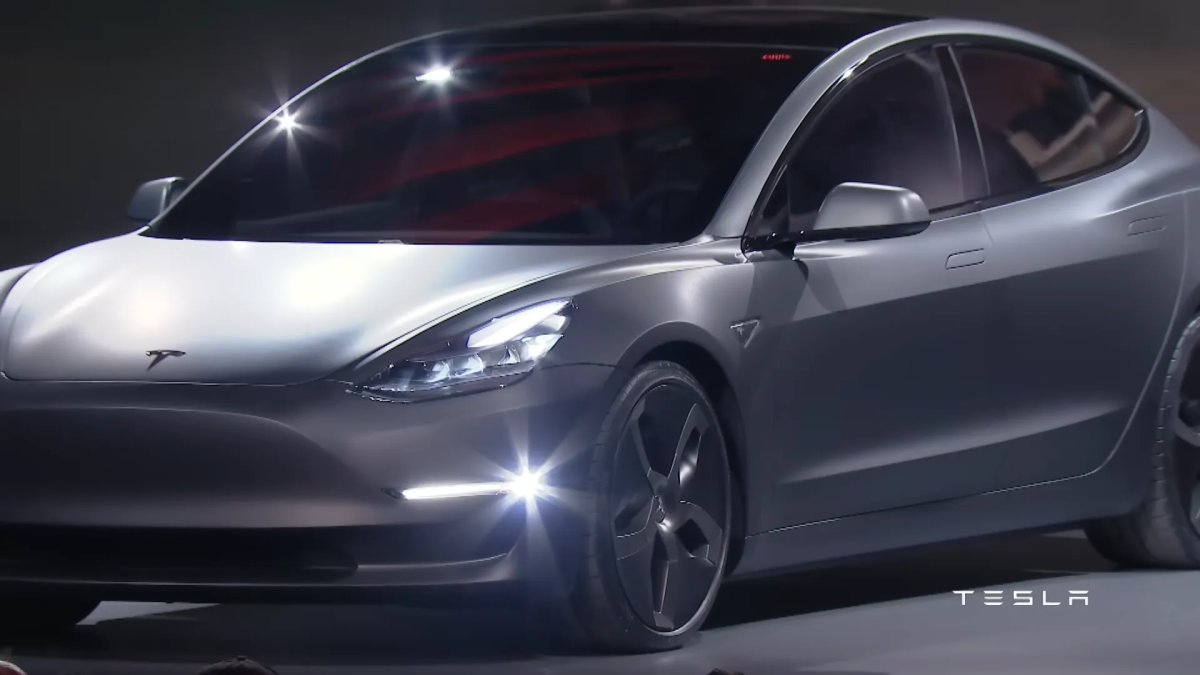
Tesla has marked ten years since the public first saw the Model 3, a vehicle that reshaped the electric-car market by proving that mass‑market electric transportation was achievable. Beyond its novel manufacturing approach, the Model 3 set new benchmarks for crash safety and for improving vehicles after delivery through software updates that established automakers continue to emulate.
Getting the car into customers’ hands meant enduring what Elon Musk called “production hell,” an intense ramp to 5,000 units per week by 2018. Before large‑scale manufacturing, Tesla presented early prototypes. Watching Tesla's official Model 3 unveiling from March 31, 2026 offers a clear look at those cars. Examining the details of those early builds reveals several features that didn’t carry over to production.
Prototype Hardware Dropped for Production
The prototype fleet included distinctive exterior and interior elements that were ultimately removed to simplify manufacturing and reduce cost for Tesla’s most affordable model.
Outside, the early builds featured Model S–style self‑presenting door handles that extended as the driver approached. Production vehicles replaced these mechanical units with the flush, manual pivot handles used today.

Inside, the concept leaned toward a stark white look. Prototype door panels and interior door handles were almost entirely white, making the white trim far more prominent than in the cars that eventually shipped.

The center console used a solid white trim plate with covers over the cup holders. While that finish didn’t reach the initial production runs, Tesla’s new three‑row, six‑seat Model Y L, which appears to be gearing up for a U.S. launch, seems to revisit this covered‑console approach. The steering wheel shown on stage also omitted the familiar physical scroll wheels, opting for a cleaner rim.

Early UI Elements That Never Made the Cut
The prototype’s central display software differed significantly from what exists now and from what early customers received. Those cars lacked the parked‑vehicle visualization on the left side of the screen; instead, nearly the entire display was devoted to navigation maps.

In that early concept, speed was overlaid directly on the map. Media controls appeared as a vertical music player on the far right edge of the touchscreen, with very large icons reminiscent of the classic interface in older Model S and Model X software. By the time deliveries began, the UI was redesigned to include a dedicated vehicle visualization on the left, maps on the right, and a clean, fixed location for the speedometer.
What’s Next for the Model 3?
Tesla’s lineup looks very different today. With half of the passenger models phased out as the company officially ended Model S and Model X orders, engineers appear to be exploring high‑performance updates for the Model 3 and Model Y. Vice President of Engineering Lars Moravy recently teased the possibility of a tri‑motor Model 3 Plaid. While future changes may focus on quicker powertrains or styling inspired by the upcoming Cybercab robotaxi, the original 2016 prototypes remain a revealing look at what might have been.



Share:
All Tesla Model Ys Now Get Black Headliner & 16-Inch Screen
Tesla App Update Hints at Upcoming Home Heat Pump Control