
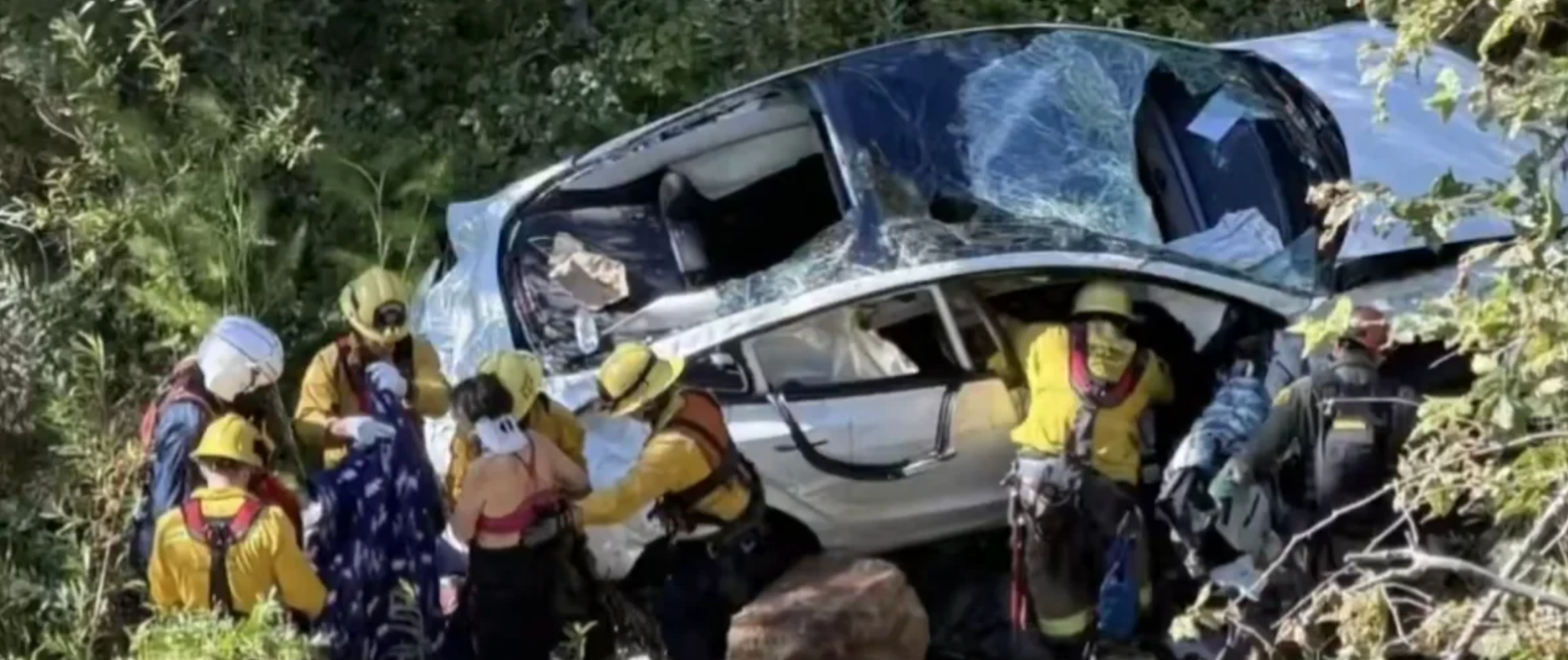

When rescue crews in Malibu responded to a 911 call along the notorious Mulholland Highway, they prepared themselves for the worst: a vehicle had veered off the road and plunged 300 feet down a near-vertical cliff. "Drivers should stop crash testing their cars! Glad they were okay. Must have been a scary drop though."
The vehicle in question was a Tesla Model 3. In almost any other car, a 300-foot drop down a rugged ravine would result in a fatal outcome. Yet, when emergency responders arrived, they found both the driver and passenger alive. The male driver had already managed to climb out of the wreckage and was actively calling for help. But here's what the traditional automotive industry doesn't want you to know: this isn't a fluke—it is the direct result of Tesla's relentless, physics-first safety engineering.
⚡ Quick Answer: Why Did They Survive?
Ultra-Low Center of Gravity
The floor-mounted battery pack prevents the vehicle from rolling repeatedly during a slide, drastically reducing chaotic impact forces.
Rigid Passenger Sanctuary
The Model 3's cabin is reinforced with ultra-high-strength steel and aluminum, designed to withstand up to four times its own weight.
Massive Crumple Zones
With no bulky internal combustion engine in the front, the "frunk" acts as a massive energy-absorbing cushion during deceleration.
Active Safety Interventions
Even in off-road excursions, Tesla's stability control and airbag deployment algorithms work in milliseconds to cushion occupants.
The Malibu cliffside rescue on May 29, 2026, has ignited massive discussions across the Tesla community on Reddit. While critics often focus on minor cosmetic panel gaps or software quirks, real-world survival stories like this serve as a stark reminder of what actually matters when you are behind the wheel. The sheer physics of a 300-foot drop means the vehicle had to absorb immense kinetic energy while maintaining the structural integrity of the passenger cabin.
Here's what you need to know. When you buy a Tesla, you aren't just buying a high-tech gadget on wheels; you are buying a highly advanced protective cage engineered to survive the absolute worst-case scenarios. No fluff. Just pure, unadulterated physics saving lives.
The Malibu Incident: What Actually Happened?
On a Friday morning, a silver Tesla Model 3 carrying two passengers veered off the edge of Mulholland Highway in Malibu, California. The vehicle descended approximately 300 feet down a steep, brush-covered cliffside, eventually coming to rest hidden by thick foliage. Because the car was obscured from the roadway, the driver's ability to quickly exit and draw the attention of passing motorists was critical to their rescue. Both occupants were airlifted by rescue crews and hospitalized with non-life-threatening injuries.
Real Owner Quote: "Low center of gravity means it's unlikely it rolled and tumbled the whole way down like an ICE might have." — Reddit user, June 2026
🎥 Watch: Rescue Crews Respond to the Malibu Cliff Incident
The Reddit community immediately pointed out the distinct physical advantages that electric vehicles, specifically Teslas, have in these terrifying scenarios. Unlike a traditional internal combustion engine (ICE ) vehicle, which has a heavy engine block up front and a high center of gravity, a Tesla's weight is concentrated entirely in its floor-mounted battery pack. This design creates a "skateboard" architecture that dramatically lowers the roll risk, keeping the vehicle upright or sliding rather than violently tumbling end-over-end.
Anatomy of Tesla Safety: The Three Pillars
Tesla's safety record isn't an accident. The company consistently sweeps 5-star safety ratings from the National Highway Traffic Safety Administration (NHTSA) and the Insurance Institute for Highway Safety (IIHS). This performance is built upon three core engineering pillars:
1. Structural Reinforcement and Material Mix
The Model 3's body structure is a hybrid of ultra-high-strength steel and aluminum. The b-pillars, roof rails, and side sills are reinforced to form a rigid safety cage around the occupants. In roof-crush testing, the Model 3's glass roof withstood over 20,000 pounds of pressure—equivalent to the weight of five fully-grown African elephants. This structural rigidity is exactly why the cabin remained intact after falling 300 feet, preventing the roof from collapsing inward on the passengers.
2. The EV "Frunk" as a Shield
In a standard gasoline car, a frontal collision forces a massive, solid metal engine block backward into the passenger cabin, often crushing the legs of the front occupants. In a Tesla, the entire front area is empty space—the "frunk." This space is specifically engineered as a giant, progressive crumple zone. It crumples systematically during an impact, absorbing and dissipating the kinetic energy before it can reach the cabin.
Tesla Model 3 Safety Design
- Floor-mounted battery prevents rolling
- Empty "frunk" acts as a massive shock absorber
- Glass roof supports 20,000+ lbs of pressure
- Advanced side-curtain airbags protect during slides
Traditional Gas Car (ICE) Design
- High center of gravity increases rollover risk
- Engine block can penetrate the passenger cabin
- Standard steel pillars are more prone to buckling
- Less space dedicated to progressive energy absorption
3. Active Safety and Millisecond Decisions
While passive safety (steel and airbags) protects you during the crash, Tesla's active safety works to prevent it entirely or minimize the impact speed. The vehicle's onboard computers process external data hundreds of times per second. In the event of an unavoidable departure from the roadway, the stability control systems work aggressively to slow the vehicle down, while the cabin prep systems tension seatbelts and prepare the airbags for deployment.
Did You Know? Tesla's Real-World Safety Data
According to Tesla's latest safety report, vehicles operating with Autopilot engaged registered only one crash per 7.63 million miles driven. For vehicles not using Autopilot, the rate was one crash per 4.31 million miles. In comparison, the NHTSA average for all US vehicles is one crash every 670,000 miles. This means a Tesla is statistically up to 11 times safer than the average car on American roads today.
The "Devil's Slide" Precedent
This Malibu crash is not the first time a Tesla has made headlines for surviving an impossible fall. In 2023, a Tesla Model Y plunged 250 feet off the infamous "Devil's Slide" cliff in Northern California. All four occupants, including two young children, survived with minimal injuries, leading local rescue chiefs to call the survival "an absolute miracle."
Why Cabin Sealing Matters in Remote Rescues
Because the Malibu vehicle fell into thick brush and was completely hidden from the highway, the occupants' physical ability to help themselves was paramount. The structural integrity of the doors allowed the driver to open them easily and climb up the steep cliffside to flag down help. Buckled doors in standard vehicles often trap occupants, delaying life-saving medical care.
Decision Framework: Safety vs. Hype
✓ Focus on Real Safety (Tesla Design)
- Physics-first structural crash cages
- Low rollover risk due to battery weight
- Continuous over-the-air safety updates
- Active collision avoidance systems
- Statistically proven lower crash rates
✗ Distracted by Media Hype (ICE/Critics)
- Over-focus on minor panel gap aesthetics
- Sensationalized coverage of rare EV fires
- Assuming all heavy cars handle poorly
- Ignoring real-world crash survival data
- Prioritizing engine sound over safety cages

The Bottom Line
When you strip away the marketing, the software features, and the stock market noise, a car has one primary job: to bring you and your family home safely.
The recent 300-foot Malibu cliff survival is not a miracle—it is a testament to calculated, uncompromising safety engineering. By utilizing the unique physical advantages of electric vehicle architecture, Tesla has built a car that defies traditional crash limitations.
If you are considering a Tesla Model 3 or Model Y, let this incident be the ultimate proof of value. When the worst happens, you'll be glad you are riding on a 1,000-pound steel-shielded battery pack surrounded by an ultra-high-strength steel cage. It is the difference between walking away and not surviving at all.
Last updated: June 2, 2026







Share:
Tesla Sales in Europe Increase As Much As 655% in May
Tesla Launches New Web-Based Dashcam Viewer