
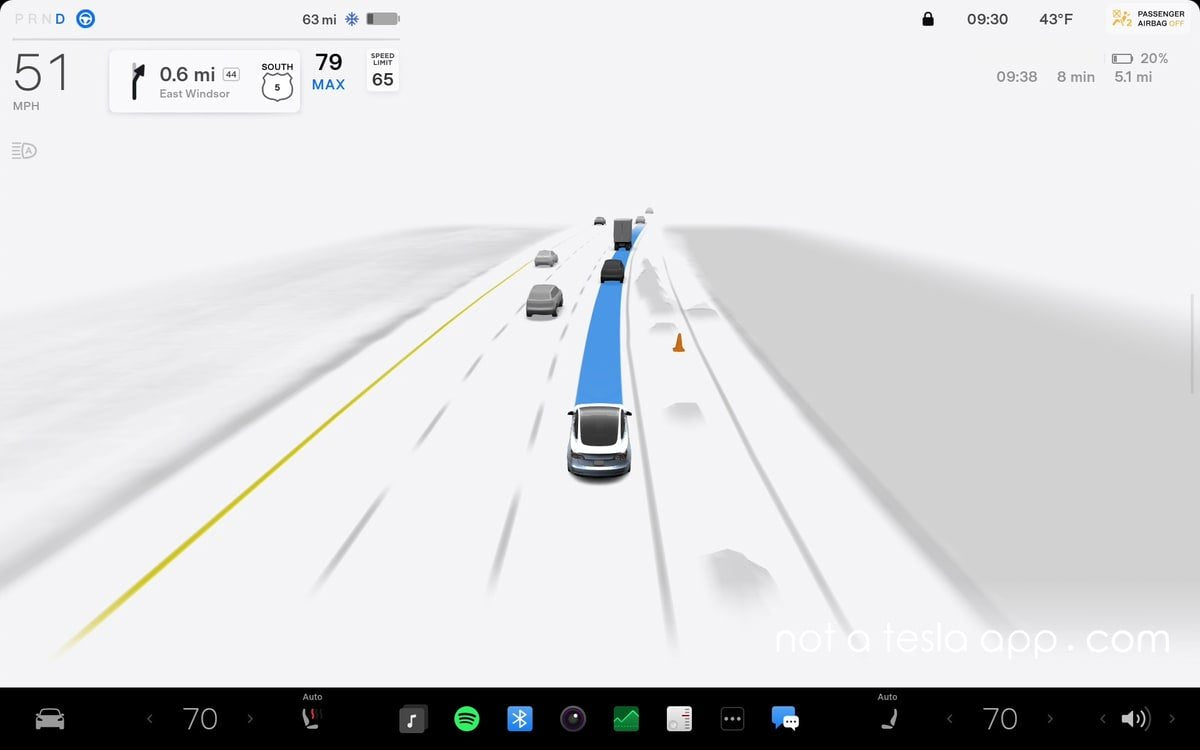
Tesla FSD To Add Pothole Avoidance and Smarter Navigation
Tesla’s Full Self-Driving (Supervised) has advanced this year with European expansion and the launch of commercial driverless Robotaxis, yet users still point to a few gaps. Common complaints focus on routing choices and rough pavement, including unexpected detours and the system driving through potholes.
In a discussion on X, Shopify executive Farhan Thawar praised FSD v14.3.10 but said broken asphalt and routing remain his biggest pain points. Tesla AI principal software engineer Phil Duan replied to confirm that “improvements on both are coming.” Source

Pothole Detection
Drivers have requested pothole avoidance since 2019. Elon Musk recently said pothole avoidance is officially coming soon, and Tesla has listed it as an upcoming improvement in release notes since FSD v14.3 earlier this spring.
Some builds have briefly exhibited this behavior. For example, a tester running FSD v14.2.2.5 recorded the vehicle gently centering over cracked asphalt so the crater passed between the tires. It’s unclear whether the system identified it specifically as a pothole or reacted to an ambiguous road anomaly, and the behavior has varied across recent FSD versions.

When Tesla formally enables pothole avoidance, those occasional maneuvers are expected to become consistent. Upcoming FSD models are set to detect damaged surfaces in real time and smoothly steer around them, reducing the need for drivers to disengage to protect wheels and ride comfort.
FSD Navigation Improvements
Navigation logic is being reworked. Although the system handles lane changes and turns, drivers frequently criticize its route selection and detours that stray from familiar commutes.
Tesla is addressing this by having FSD learn from daily habits. The system will interpret driver interventions—such as manual lane selections and steering nudges—as training feedback. If a driver routinely rejects a mapped detour to take a preferred highway exit or surface street, FSD will remember and prioritize that choice on future trips. This builds on the new Preferred Routes feature.

This learning will extend to parking. Upcoming builds will observe patterns—such as backing into a driveway, leaving space near a garage wall, or stopping a bit farther from a high curb—and then attempt to mirror those preferences when parking autonomously.

Other Upcoming FSD Features
Beyond pothole sensing and routing updates, Tesla is working on integrating Grok directly into the FSD stack so drivers can use natural voice instructions—for example, asking the car to take a specific turn, park in a particular spot, or alter the route. In addition, the recently launched Automatic Collision Evasion feature can reengage FSD during manual driving.
Pothole avoidance was first noted in the v14.3 release notes, but it’s unclear whether these updates will land in a near-term point release or arrive with the upcoming FSD v15 architecture, which is expected to deliver a neural network upgrade to 10 billion parameters.






Share:
Giga Shanghai Model 3/Y Add V2L, Zen Gray, 16" Screen
Emergency Drive Away Arrives in 2026.38.3 for U.S. Superchargers