
Tesla FSD Cuts Collisions by 40% in Australia and NZ
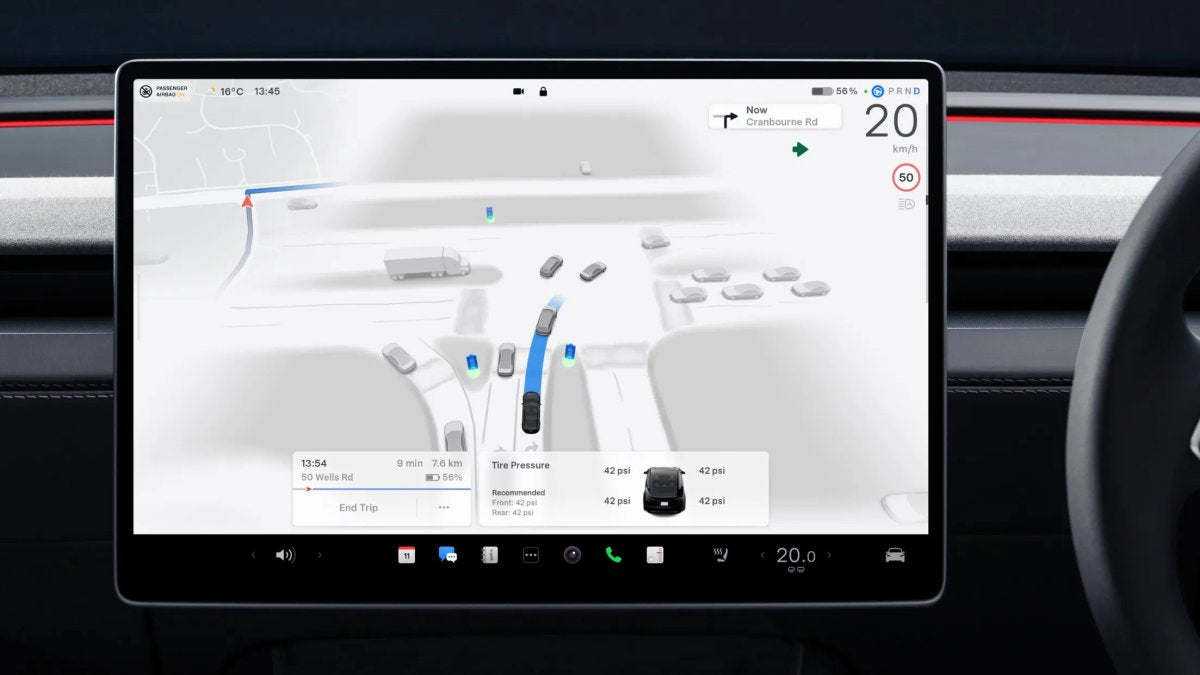
Tesla has shared official safety data for Australia and New Zealand after 12 months of FSD (Supervised) availability, revealing 40% fewer collisions compared to manual driving.

After its first full year on the road in Australia and New Zealand, Tesla’s Full Self-Driving (Supervised) shows notable safety gains. According to data shared by Tesla’s regional account on X, vehicles using FSD (Supervised) experienced, on average, 40% fewer collisions than vehicles driven manually.
Tesla first launched FSD (Supervised) in Australia and New Zealand in September 2025. At the time, the two nations became the fifth and sixth countries globally to gain access to the driver-assistance software.

Breaking Down the Safety Numbers
The fleet data covers travel between September 17, 2025, and September 16, 2026, comparing 160 million kilometers driven on FSD (Supervised) with 2.4 billion kilometers driven manually while active safety features were enabled.
Considering both major and minor collisions, vehicles operating on FSD recorded one collision every 1.78 million kilometers, versus one event every 1.07 million kilometers under manual driving — a 40% reduction in crashes.
Additional metrics also improved with FSD engaged:
- Automatic emergency braking instances dropped by 66%, triggering once every 17,432 kilometers on FSD compared to once every 5,989 kilometers manually.
- Harsh braking events fell by 90%, occurring once every 1,823 kilometers on FSD versus every 180 kilometers during manual travel.
- Harsh acceleration decreased by 86%, while harsh lateral cornering events declined by 76%.
- Horn usage fell by 80%, sounding once every 3,233 kilometers with FSD active compared to every 643 kilometers under manual control.

Global Expansion and Software Updates
Australia and New Zealand’s first year with FSD (Supervised) is part of a broader international rollout. FSD has expanded to 14 countries worldwide, gaining momentum as more European nations adopt it. Slovenia approved FSD (Supervised) earlier this month, becoming the latest nation to greenlight the technology. Here is the current global footprint:
| Region / Market | Official Launch Date | Hardware Supported at Launch |
|---|---|---|
| United States | October 2020 | Hardware 3 (HW3) |
| Canada | March 2022 | Hardware 3 (HW3) |
| Mexico | February 2025 | Hardware 4 / AI4 |
| Puerto Rico | February 2025 | Hardware 4 / AI4 |
| China | February 2025 (Limited) | Hardware 4 / AI4 |
| Australia | September 2025 | Hardware 4 / AI4 |
| New Zealand | September 2025 | Hardware 4 / AI4 |
| South Korea | November 2025 | Hardware 4 / AI4 |
| The Netherlands | April 2026 | Hardware 4 / AI4 |
| Lithuania | May 2026 | Hardware 4 / AI4 |
| Estonia | May 2026 | Hardware 4 / AI4 |
| Denmark | June 2026 | Hardware 4 / AI4 |
| Belgium | June 2026 | Hardware 4 / AI4 |
| Slovenia | September 2026 (Pending Rollout) | Hardware 4 / AI4 |
Software updates have advanced alongside this geographic expansion. Earlier this summer, Tesla rolled out FSD v14 in Australia and New Zealand, introducing its latest end-to-end neural network architecture to the region. Owners in both countries began with FSD v13 at launch. Tesla is expected to start rolling out FSD v15 later this year or early next year, and the update will eventually reach Oceania.
Owners with Hardware 3 vehicles are anticipating an upgrade as well. Tesla confirmed last month that FSD v14 Lite is in active development for both countries, providing a distilled model tailored to run smoothly on legacy processors.
As Australian and Kiwi fleets log their next 100 million kilometers, real-world data continues to offer regulators the safety metrics needed to move FSD (Supervised) toward wider adoption.







Share:
Tesla AI5 Chip Enters Trial Production at Samsung's Texas Fab
Tesla Adds Passkey Support to Tesla App