
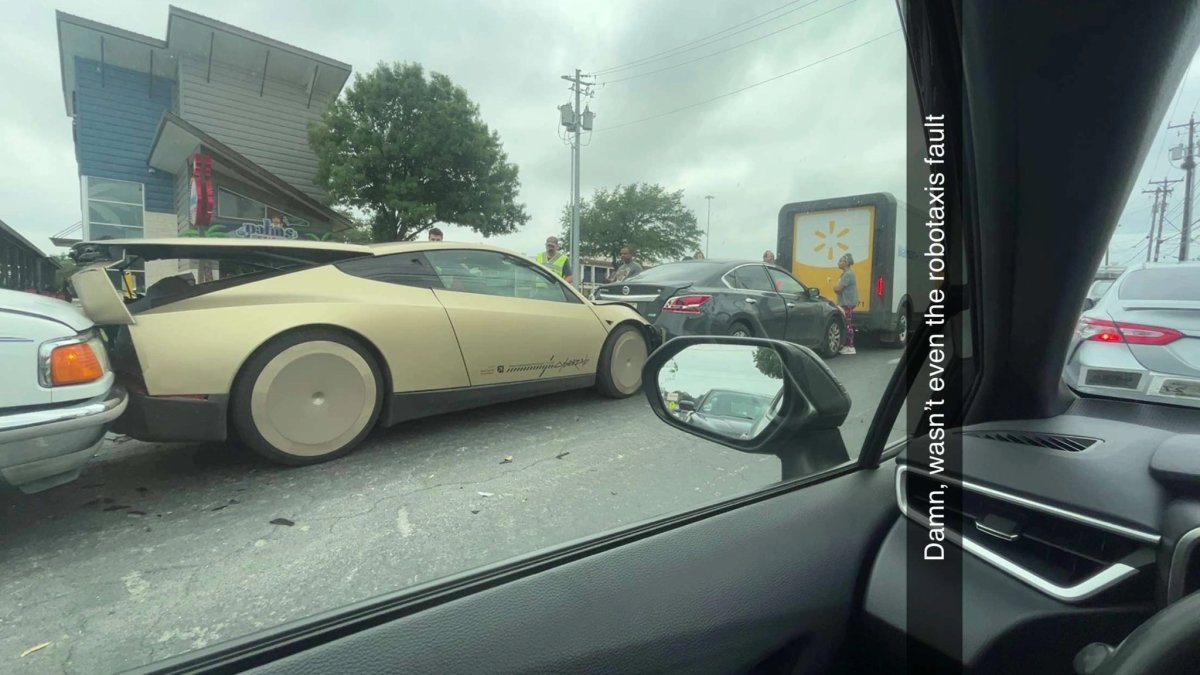

Tesla is advancing its push toward autonomy by testing its purpose-built Cybercab on public roads. As more of these vehicles operate in traffic, they inevitably encounter the variability of human driving. An image shared online appears to show the first recorded public-road incident involving a Tesla Cybercab, and the initial impression is that the robotaxi was not at fault.
The post came from @bigcolll, who shared a photo of a champagne gold Cybercab in what looks like a multi-car chain collision. Based on the image, the Cybercab seems to have been struck from behind, which then pushed it into the car ahead. Community reactions noted that many Cybercab collisions may end up being rear-end impacts by human drivers, a pattern consistent with other autonomous fleets such as Waymo, where rear-end crashes caused by distracted human drivers are a leading source of incidents.
Mass Production at Giga Texas
Spotting a Cybercab on public roads aligns with Tesla having officially kicked off mass production of the vehicle at Gigafactory Texas last month. Unlike the matte-finished prototypes seen since its 2024 unveiling, current production vehicles use unique glossy body panels.

Tesla is building a mix of Cybercab configurations, including vehicles without steering wheels or pedals. The company has a "Plan B" to add traditional controls if required by law, but the target is a fully autonomous fleet that requires zero human intervention. Entire fleets staged at Giga Texas indicate the rollout is scaling quickly.
Expanding the Unsupervised Network
This incident coincides with a rapid expansion of Tesla’s Robotaxi service. Last month, the company launched fully unsupervised rides in Dallas and Houston, a milestone distinct from the Bay Area service, which still relies on safety drivers; in these Texas markets, the front seats are truly empty.

The Cybercab is intended to serve as the backbone of the network, providing a more cost-effective, purpose-built option for ride-hailing than the Model Y. Regulatory data indicates robotaxis are closing in on human-driver parity for safety, but minor "fender benders" like this illustrate the challenges of blending AI-driven and human-driven traffic.
As production scales to hundreds and thousands of Cybercabs per week, more of these vehicles will appear across U.S. cities. While any crash is undesirable, the fact that this first known Cybercab incident appears to be a routine rear-end impact by a human driver could support Tesla’s position that its AI is the safer operator.





Share:
Tesla Introduces New Remote Meter for Wall Connector
SpaceX Files for TERAFAB Construction Site in Texas