
Tesla’s dedicated hardware for its autonomous ride-hailing effort is now appearing in regulatory filings. As Cybercab production scales, a newly published patent offers a closer look at the robotaxi’s wheel design.

Design patent details
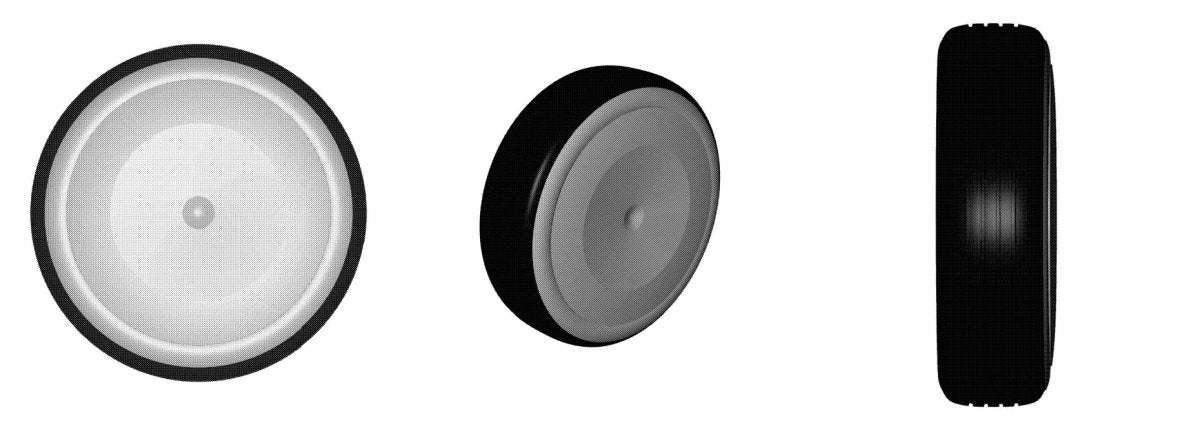
The United States Patent and Trademark Office published patent number US-D1130251-S, which protects the ornamental design of the Tesla Cybercab’s wheels. While this design filing doesn’t reveal much in terms of technical specs, it confirms the tire design and wheel configuration seen publicly so far.
The patented design centers on a flat, gold hubcap that snaps over the rim, sealing air pockets to improve aerodynamic efficiency. The covers may also help visually mask the chunky tire profile and the distinctive wheel setup.

A closer look at the gold wheel covers
A recent X post from @Tslachan showed the gold disc being pulled away from the rim for inspection. The outer edge appears to be a flexible rubber that sits flush with the stock Continental tire’s sidewall. Using flexible rubber helps keep the cover from cutting into the tire as it flexes; a harder edge would increase friction wear. There is even some black tire material visible on the inside of the shield.

The center section that sits over the rim looks to be a harder material, possibly an automotive-grade plastic such as ABS or polypropylene.
An unprecedented FWD layout
The Cybercab’s wheel sizes and drive layout are unusual for the industry: the front axle uses 215/60 R18 tires, the rear moves up to a 21-inch wheel with a tall 225/60 R21 truck-sized tire, and the vehicle is front-wheel drive (FWD).
According to a technical analysis by longtime Tesla owner @AlexEdgerton, the Cybercab is the world’s first FWD vehicle with a staggered wheel setup. Some factory vehicles use a reverse stagger (wider fronts) to reduce understeer, and it is also a common FWD track-car modification, but there are no production FWD cars with larger rears.

The move to FWD diverges from Tesla’s prior platforms but lines up with utility-fleet priorities. "Unlike traditional rear staggered set ups that give the drive wheels extra traction, aerodynamics and cost-per-mile override traditional performance logic on the Cybercab," noted Edgerton. "It features a heavily tapered teardrop shape, which is the most efficient for reducing drag."
Adding to this, the smaller front tires will result in better steering freedom, while the massive 32-inch rear tires will not only make the ride more comfortable by better absorbing bumps and potholes but also spin fewer times per mile to prolong tire life.
Scaling production for the robotaxi network
This wheel architecture is one of several specialized elements entering Cybercab production. Others include larger front-facing windshield cameras for Full Self-Driving, Tesla’s first interior trunk camera to monitor riders’ luggage, and a cabin entirely free of a steering wheel or pedals.
The regulatory route for driverless service is also clarifying, especially after NHTSA recently dropped brake pedal requirements for autonomous vehicles. Tesla has already started Cybercab mass production at Giga Texas, where lines are producing a mix of steering wheel-less Cybercabs and units with manual controls as the commercial launch on Tesla’s Robotaxi network approaches.






Share:
Volkswagen to Cut 100,000 Jobs as Tesla and China Close In
Tesla Releases Q2 2026 Analyst Delivery Consensus