

The National Highway Traffic Safety Administration (NHTSA) held its first National AV Safety Forum in Washington, D.C., bringing together federal regulators alongside executives from Tesla, Waymo, Zoox, and Aurora. Conversations focused on modernizing federal automotive rules to enable innovation and support an America-first approach to transportation technology.
Rethinking FMVSS
Transportation Secretary Sean Duffy highlighted the need to update the Federal Motor Vehicle Safety Standards (FMVSS). Current standards require traditional human controls such as a steering wheel, mirrors, and pedals—requirements that pose a significant hurdle and added expense for purpose-built robotaxis.
"If you have an autonomous vehicle, do you need a steering wheel? We have to rethink some of our requirements, especially for autonomous vehicles, which will allow them to bring down the price, maintain the safety structure, but move forward and be competitive with the rest of the world."
Exempting autonomous networks from these hardware mandates is a critical step. Removing steering columns and pedal boxes would reduce manufacturing complexity and lower overall vehicle costs.
U.S. Transportation Secretary Sean Duffy at the first autonomous vehicle safety forum today:
— Sawyer Merritt (@SawyerMerritt) March 10, 2026
“A lot of our top innovators from Waymo, Zoox and Tesla are here, and we're going to have a day long conversation; If you have an autonomous vehicle, do you need a steering wheel? We… pic.twitter.com/24RkCv9Sur
Safety First, But America First
Federal officials emphasized that any regulatory changes will continue to prioritize passenger safety and require rigorous validation before wider deployment approvals.
"If it wasn't safe, we would shut it all down,"
The Department of Transportation signaled an intent for the U.S. to lead the global autonomous vehicle race, with a strong emphasis on an America-first stance for AI and automotive innovation.
Cutting Local Red Tape
A uniform federal framework would also address state-by-state regulatory fragmentation that complicates deployment for companies like Tesla.
Automakers currently contend with a patchwork of municipal and state rules, with states such as California and New York imposing strict local hurdles that slow rollout timelines.
"We don't want 50 states with 50 standards; we want one national standard".
Sweeping federal AV legislation would establish a single, nationwide standard and override localized bottlenecks. For Tesla, such standardization would enable faster scaling of its Robotaxi fleet across the country without prolonged, piecemeal regulatory battles.
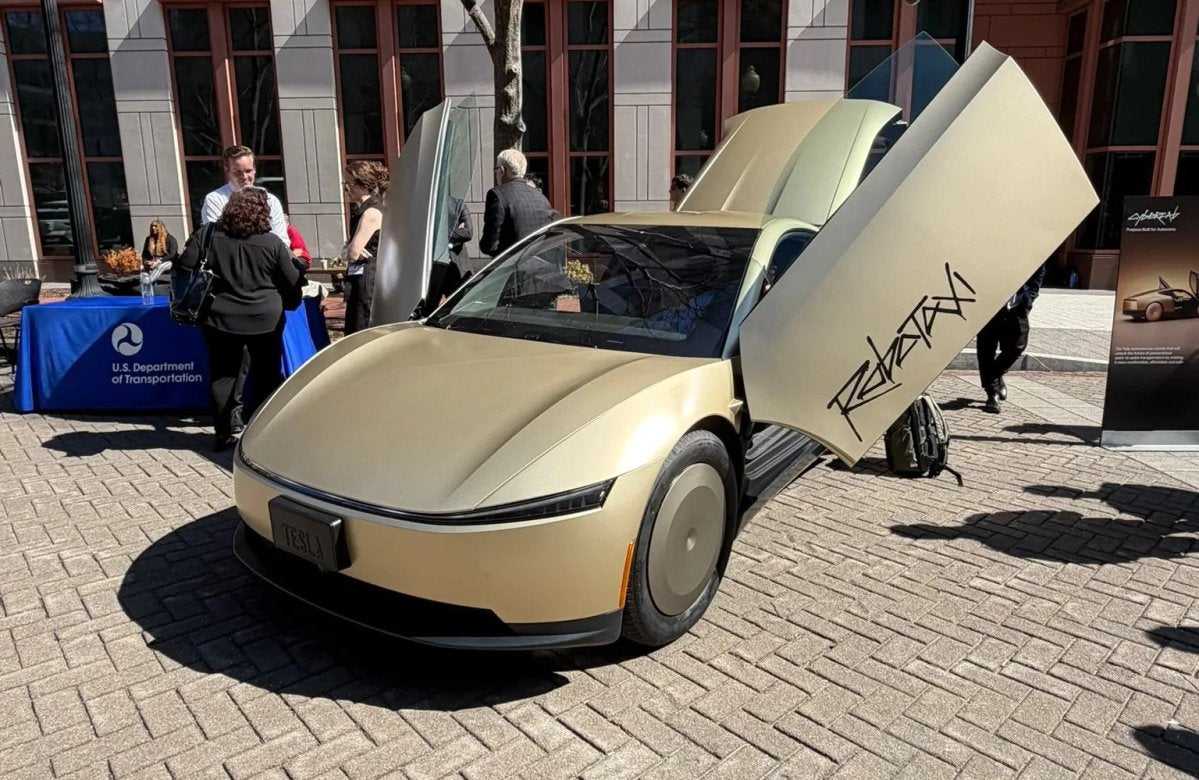
Cybercab Arrives in D.C.
Tesla Cybercab on display at the USDOT in Washington, DC pic.twitter.com/BceYXr5P3b
— Moe (@moemoe889) March 10, 2026
Tesla brought a production iteration of its upcoming Cybercab to the forum, featuring the additional new hardware seen to date and new changes such as a bigger cabin camera, a camera in the trunk and more.
Presenting the pedal-less, wheel-less Cybercab directly to lawmakers and regulators allowed hands-on interaction with its minimalist interior and autonomous sensor suite, underscoring why legacy FMVSS requirements are obsolete for the next generation of transportation.



Share:
Bank of America Resumes Coverage on Tesla & Rivian; Sets Stock Targets
Real-World Test Shows Tesla Semi Running at Just 15¢ Per Mile — Far Below Diesel