
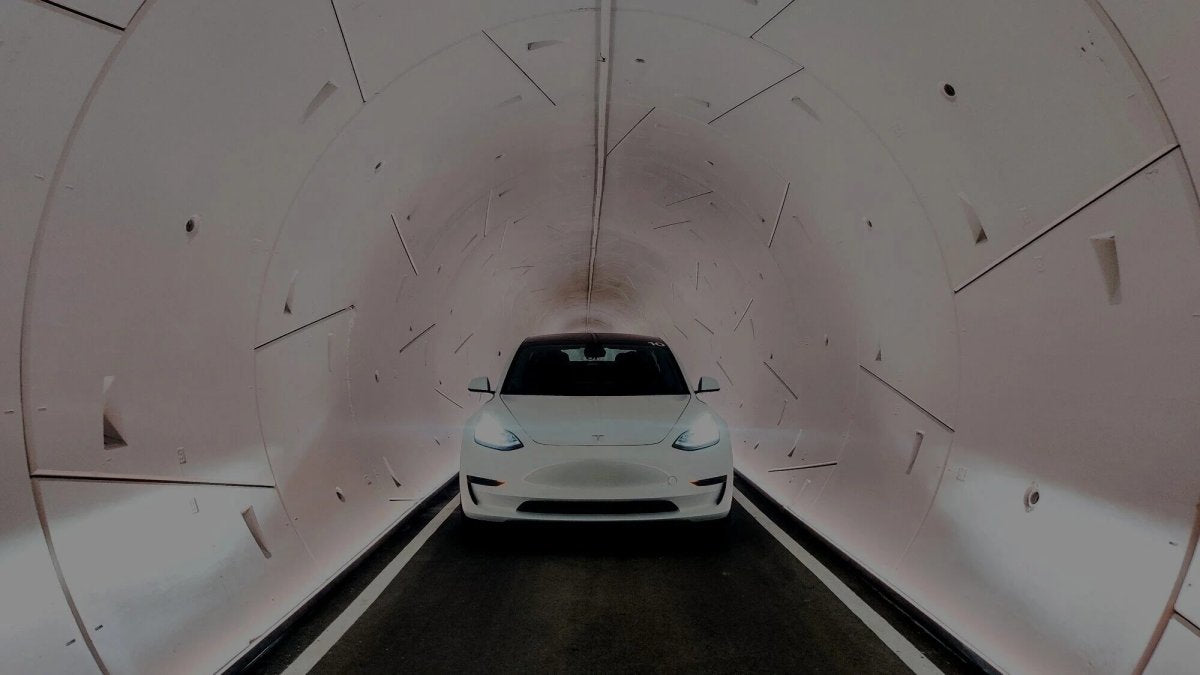
Boring Company plans 30-minute Austin to San Antonio tunnel
Commuters traveling between Central Texas’ two largest metropolitan areas may one day bypass I-35 entirely. Elon Musk said The Boring Company is developing a high-speed underground link between Austin and San Antonio.
Musk shared that the company is planning a “simple, precursor Hyperloop tunnel” joining the two cities, with targeted travel speeds in excess of 200 mph. He added that the trip currently can take up to two-and-a-half hours because of traffic, but the tunnel aims to reduce it to 30 minutes or less.
The roughly 80-mile corridor at speeds exceeding 200 mph would significantly reshape mobility in the region. Musk did not provide a construction start or completion timeline, noting only that active planning is underway.

Expanding the Texas tunnel footprint
The route would be a logical expansion of tunneling efforts in Texas. Austin is Tesla’s global corporate headquarters and home to Gigafactory Texas, making enhanced regional connections a clear priority.
The announcement follows news from earlier this spring, when The Boring Company announced three new tunnel projects it will be building for free, including a municipal route in Dallas. Moving toward an inter-city corridor represents a shift from localized shuttles to broader regional transit.
How the precursor Hyperloop works
Unlike a full Hyperloop—envisioning passenger pods traveling through sealed vacuum tubes at near-supersonic speeds—a precursor tunnel focuses on high-speed electric transport within a streamlined underground tube.

In current deployments such as the Las Vegas Convention Center Loop, standard Tesla vehicles carry passengers between underground stations, avoiding surface crowds and traffic.
An 80-mile trunk line between Austin and San Antonio could operate differently. Because Tesla already runs fully unsupervised Cybercab and Model Y robotaxis on public roads in Austin, this long-distance tunnel could become the first dedicated underground corridor for driverless fleets. With no surface weather, cross traffic, or unexpected hazards, autonomous vehicles could maintain 200 mph speeds.

Securing right-of-way and tunneling 80 miles through Texas limestone will take time. If realized, the daily grind on I-35 could be replaced by an underground trip of 30 minutes or less.








Share:
What the Cybercab's Consumer-Facing UI Looks Like
Tesla Teases Roadster at Semi Event, Hints at Design Changes