
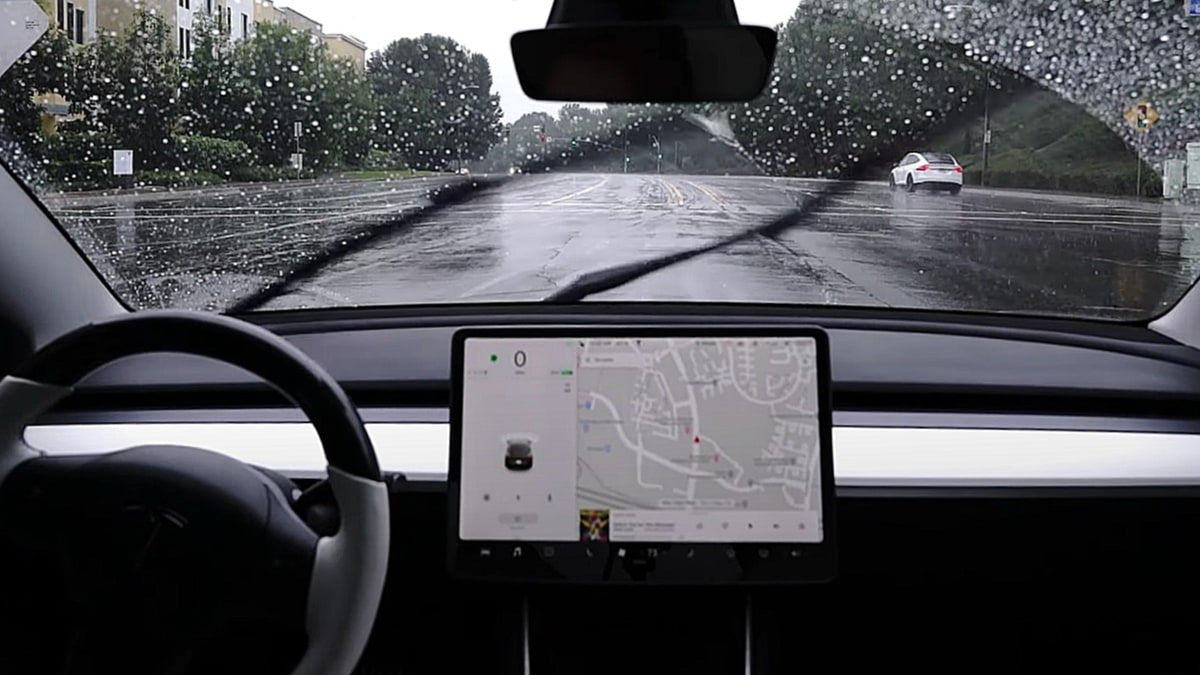

Owners of Tesla vehicles have long criticized the dry wipe behavior that stems from relying solely on cameras instead of traditional infrared rain sensors to detect precipitation. A newly published patent titled "Wiper Friction Estimation for Autowiper Performance Improvement" describes a software-based solution to this issue.
Tesla engineer and co-inventor Yun-Ta Tsai confirmed on X that this capability is already active across the entire fleet and becomes even smarter in the FSD v14.3 update.
The Energy Balance Model
Rather than depending only on camera imagery to infer a wet windshield, the approach measures the physical resistance experienced by the wiper blade. The vehicle's Body Control Module applies an advanced energy balance model.
It precisely monitors the electrical power delivered to the wiper motor using internal voltage and current sensors, then accounts for known efficiency losses. These include electrical losses in the motor, frictional losses in the mechanical wiper linkage, and aerodynamic drag on the blade due to the vehicle's current speed.
By balancing the electrical power input against these mechanical and aerodynamic losses, the system isolates the friction occurring directly between the rubber blade and the glass.
For accuracy, the system primarily computes this friction during the middle portion of the wiper's arc, where the blade moves at its highest velocity and lowest acceleration, yielding a cleaner signal.
Giving FSD the Sense of Touch
This continuous stream of friction data provides a direct feedback loop to the Autopilot ECU. If cameras give the vehicle sight, friction estimation gives it a sense of touch.
Friction allows us to feel what material is on the glass, so we could promptly trigger a wash if needs to.https://t.co/h0pn0oRFaC
— Yun-Ta Tsai (@yunta_tsai) April 10, 2026
By analyzing physical friction, the vehicle can immediately infer what is on the glass without relying purely on the cameras:
- Dry Glass and Grime: If the estimated friction is significantly higher than expected, the system knows the glass is completely dry or covered in sticky debris. This prevents further abrasive dry wiping and can automatically trigger the washer fluid to clear the obstruction.
- Ice and Frost: If friction is unusually low under wet conditions, the system can detect a slick layer of frost or ice on the windshield. The vehicle can then automatically activate the climate control system and defrost functions to melt the ice.
- Worn Blades: By monitoring these friction values over time, the system can even detect when the rubber wiper blades are degrading and automatically alert the driver that it is time to replace them.
Already Deployed and Evolving in v14.3
Although patents often point to future hardware, this friction estimation is a software innovation. Tsai says this logic has already been implemented across the fleet via over-the-air updates, allowing the system to feel the material on the glass so it can promptly trigger a windshield wash when needed and detect when a dry wipe has occurred.
Tsai also teased further winter-weather improvements based on this technology, including better wiper-fluid control, defrosting, and defogging behaviors, which are bundled into the FSD v14.3 update.


Share:
Tesla Rolls Out Safety Score 3.0: More Precise Score, Adjusts Factors and Cheaper Insurance for FSD
Tesla Updates Energy App in Spring Update (2026.14): Custom Trips, Pause and New Widgets [VIDEO]