
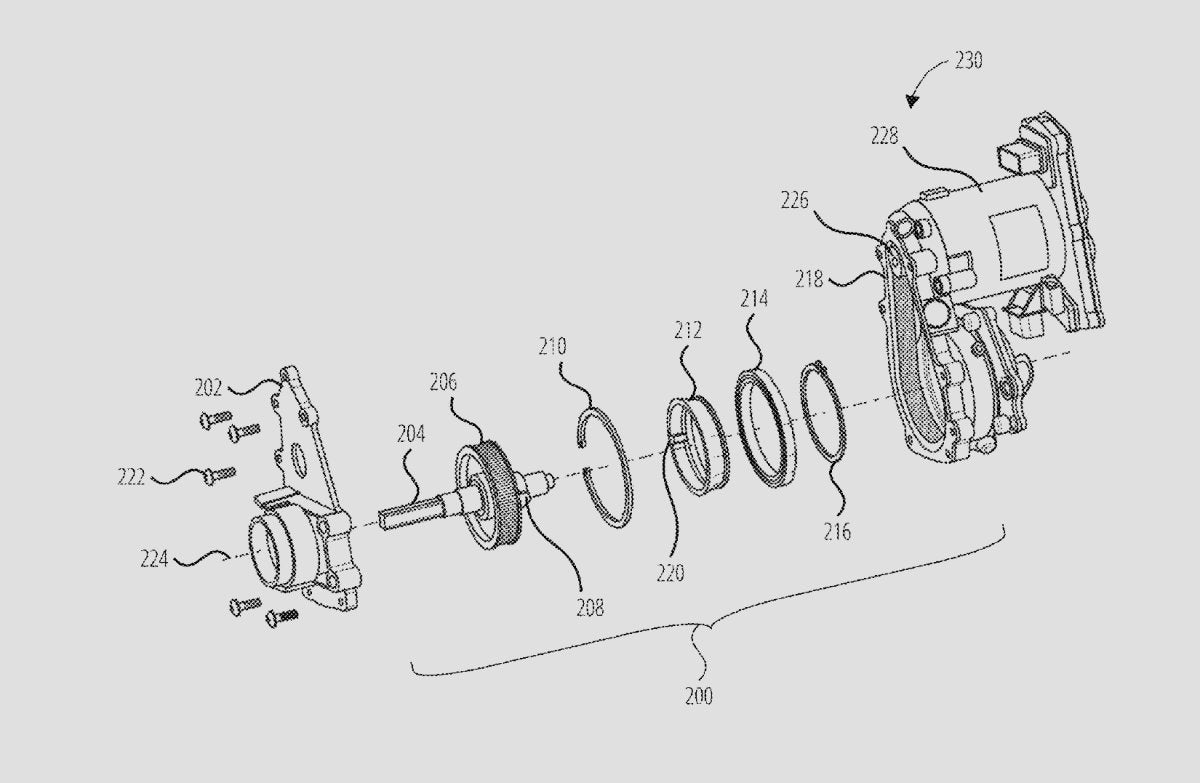

Tesla has disclosed a patent that could influence how future steer-by-wire vehicles behave. The patent is titled "MULTI-TURN STEERING FEEDBACK ACTUATOR" and was published on March 19, 2026.
Credited to inventors Stephen Alexander Harasym and Joel Timothy Van Rooyen, the filing describes a steering column assembly tailored for steer-by-wire systems. It enables a greater steering wheel rotation range while retaining a durable mechanical end stop.
The Problems with Current Steer-by-Wire
In modern steer-by-wire setups, steering feedback actuators provide resistive force to mimic the feel of a conventional mechanical steering system. These systems also need travel limiters so the wheel cannot be turned far enough to harm internal parts.
Traditional actuators typically rely on mechanical pins or stoppers within the housing to cap the steering wheel’s motion. They create a firm hard stop at fixed angles, commonly around plus or minus 170 degrees from center. That figure is essentially 180 degrees, but it is reduced slightly by the width of internal components that would otherwise collide.
Tesla’s Two-Stage Solution
To overcome this cap on rotation, Tesla proposes a straightforward mechanical layout. The steering column assembly includes an input shaft with a pin, a stationary housing, and a rotating stop ring. The stop ring provides two distinct stops: one that engages the housing and another that engages the pin on the input shaft.
Because the stop ring can rotate on its own before it meets the final housing stop, the total steering range increases substantially. This two-stage approach allows steering ranges of approximately plus or minus 340 degrees.
The design yields far more rotation than conventional systems while remaining compact and efficient. It is also highly tunable: engineers can configure the stop ring to restrict motion to any value between 170 degrees and 340 degrees, and the patent mentions the potential for an arc of at least 540 degrees.
Premium Feel, Variable Feedback
The patent also emphasizes steering feel. Striking a hard stop can be abrupt, so the assembly incorporates damping features to soften contact. Specifically, it uses polymer O-rings that protrude at contact surfaces.
When the steering reaches its limit, these O-rings expand upon impact, adding resistance and cushioning the stop. The result is a softer, more refined sensation at the end of travel. The assembly also interfaces with existing feedback hardware, using a gear or pulley on the input shaft connected to a belt drive system and a motor to generate variable feedback torque and emulate the resistance and road feel of a traditional steering rack.
Built for the Future
Despite its minimal parts count, the design is built to tolerate high input torques. It could help reduce manufacturing costs and boost reliability in upcoming Tesla vehicles. Whether it first appears in the next-generation Roadster or a future iteration of the Cybertruck, the company is laying groundwork to advance its steer-by-wire technology.
















Share:
Wall Street Analyst Predicts Tesla & SpaceX Will Merge by 2027
Tesla FSD Global Roadmap: Is Your Country Next?