
How Tesla’s FSD Hardware Has Changed Over the Years

Tesla’s Autopilot and Full Self-Driving (FSD) hardware timeline shows how challenging it is to approximate human vision and reasoning.
For more than a decade, Elon Musk has said vehicles produced today include all the hardware required for full autonomy, yet successive releases have repeatedly introduced newer and more capable systems. The industry is now approaching true autonomy, but it has taken years, multiple hardware generations, and likely more updates ahead.
From the early Mobileye era with a single forward camera to the distributed supercompute ambitions of AI5, here’s how Tesla’s hardware has progressed.
Hardware 1: Mobileye
The first Autopilot hardware (AP1) was based on Mobileye technology commonly found in other premium vehicles. It used one forward-facing camera paired with a Mobileye EyeQ3 chip.
This setup could track lane markings and the vehicle immediately ahead but lacked awareness of most other situations. It did not recognize stop signs, traffic signals, or vehicles merging into blind spots. In practice, it enabled TACC and basic lane keeping, but not much beyond that.
AP1 also included radar and ultrasonic sensors (USS). Radar helped detect objects ahead that the narrow field-of-view camera could miss, while USS aided with parking.
This phase ran from 2014 to 2017 before giving way to Hardware 2.0.
Hardware 2 & Hardware 2.5: Colorblind
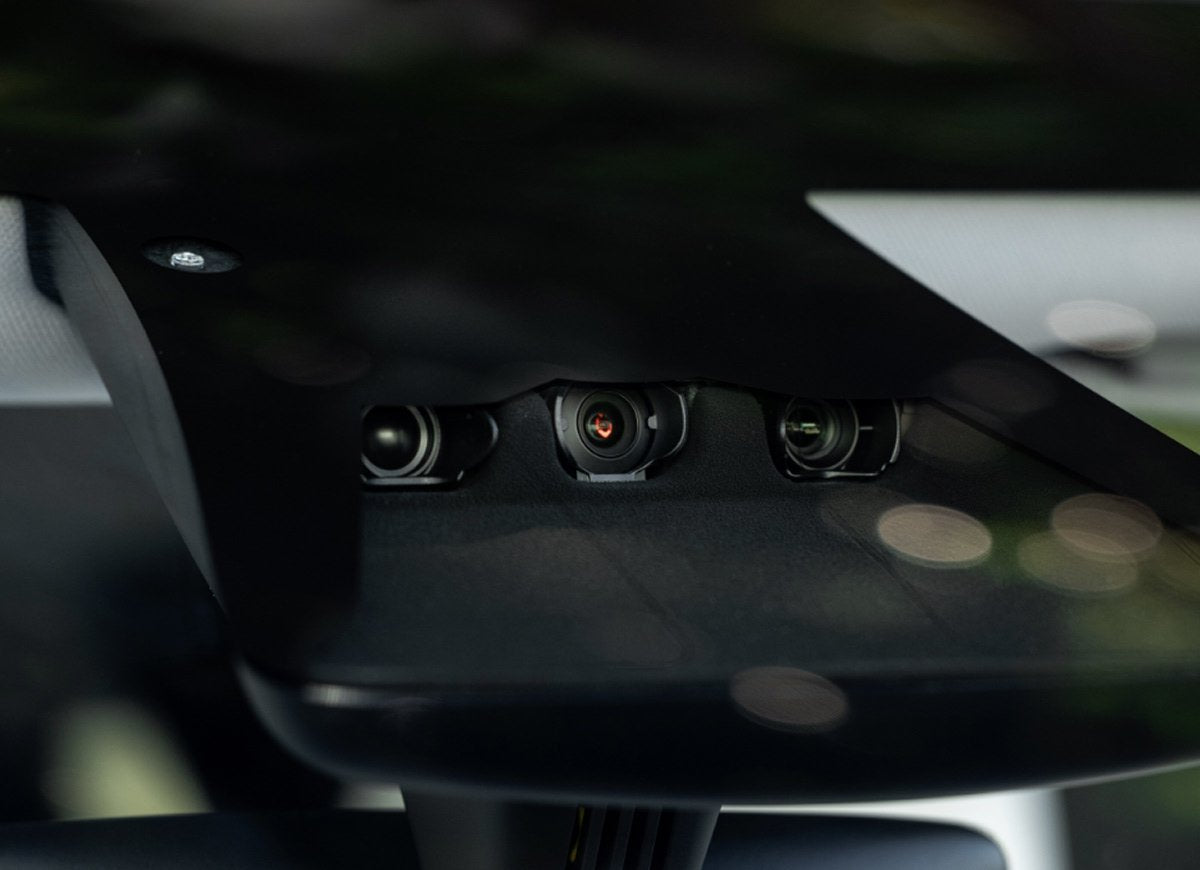
After ending its Mobileye partnership in 2016, Tesla built its own vision-based stack. Hardware 2 (HW2) introduced eight surround cameras, delivering an almost 360-degree view.
To boost low-light performance, Tesla used RCCC (Red-Clear-Clear-Clear) sensors. They were strong at detecting contrast features such as lane lines and red lights, but were effectively colorblind otherwise. Footage from this period often appears washed out and sepia-like.
Processing moved from Mobileye’s EyeQ3 to NVIDIA’s Drive PX2, which struggled to handle all eight video feeds concurrently at full frame rates.
In mid-2017, Tesla rolled out Hardware 2.5. Camera hardware was largely unchanged, but a secondary compute node was added for redundancy, and a new Continental radar with greater range was introduced.
HW2/2.5 spanned 2016 to 2019, with many vehicles later upgraded to the next generation.
Hardware 3: Big Brain

With Hardware 3 (HW3), Tesla moved fully to in-house compute, replacing NVIDIA’s PX2 with its custom HW3 FSD Computer.
Compute performance jumped from ~20 TOPS on PX2 to 144 TOPS, enabling the system to process all 8 cameras at full resolution and frame rate. Cameras moved to 1.2-megapixel sensors with tinted color for the first time, though the resolution was still limited for long-range detail and sign legibility.
Even so, HW3 was not sufficient to achieve FSD Unsupervised. Tesla maintains it will deliver FSD v14-Lite to HW3 owners and will upgrade vehicle computers in the future once true autonomy is achieved with AI4, the current hardware generation.
During HW3’s run, Tesla began removing radar from new builds. Later Model 3 and Model Y shipped without radar, while Model S and Model X retained hardware that remained deactivated for a period.
Mid-cycle, Tesla also eliminated USS, transitioning to Tesla Vision for the first time.
HW3 lasted from 2019 to 2023, the longest run of any generation so far.
Hardware 4 (AI4): Big Brain 2: High Definition

Hardware 4, or AI4, brought major upgrades to the camera suite and matching compute. Sensors jumped from 1.2MP to ~5MP, moving vision quality closer to 20/20. Tesla also switched to RGGB sensors for accurate color reproduction.
Newer iterations add a front bumper camera, first seen on Cybertruck and now present across the refreshed lineup. This camera covers the area right in front of the bumper, improving precision during low-speed maneuvers such as parking.
Additional changes appear to be in testing, including a rear camera washer for the first time on a Tesla vehicle, spotted on Cybercab prototypes in Austin, Texas, though this has not been observed in production vehicles yet.
Hardware 4.5

Tesla has revealed an updated AI4 computer, internally called AI4+ or HW4.1, positioned as a bridge between today’s AI4 and the more powerful AI5 platform.
The headline change is memory. Current AI4 systems provide 16GB of RAM per SoC (32GB total across the dual-chip design). AI4+ doubles this to 32GB per SoC, for 64GB total, allowing larger neural networks and future FSD models to run without immediately requiring AI5.
Tesla also indicates AI4+ will offer roughly 10% more compute performance and 10% higher memory bandwidth.
HW4+ is slated for mid-2027.
AI5: Distributed Supercompute

AI5 (also known as HW5) is the next-generation AI computer that will succeed AI4/HW4, representing Tesla’s biggest hardware leap since its first in-house FSD computer arrived in 2019.
Tesla is targeting 2,000–2,500 TOPS, versus roughly 500 TOPS for AI4—performance on par with top-tier consumer GPUs and NVIDIA’s datacenter offerings like the H100.
That translates to approximately 3–5x more compute than AI4, with some AI workloads potentially seeing even larger improvements.
Given AI’s heavy memory demands—highlighted by the AI4+ RAM increase—AI5 could raise memory capacity by 9x.
AI5 will not debut in vehicles. It is planned to appear first in Optimus, with vehicles expected to receive AI5 in late 2027. In light of the AI4+ timeline, one of these schedules may shift: either AI4+ arrives earlier than expected, or vehicle integration of AI5 is pushed to 2028.
The Path Forward
Tesla’s hardware evolution underscores necessity over sufficiency. Every generation except AP1 was presented as the final step, only to become a stepping stone. The company has acknowledged autonomy has been harder to solve than anticipated.
With FSD v14 and AI4, Tesla appears close to its autonomy goals, but AI4 is not the endpoint. AI4+ is coming, followed by AI5.
While projected compute for AI4+ and AI5 is known, details about future camera modules and camera-cleaning systems remain uncertain.


Share:
Tesla Opens Supercharger Access to Volvo EVs in Europe
Tesla Reveals the Real Reasons Behind the Model S and Model X Cancellation